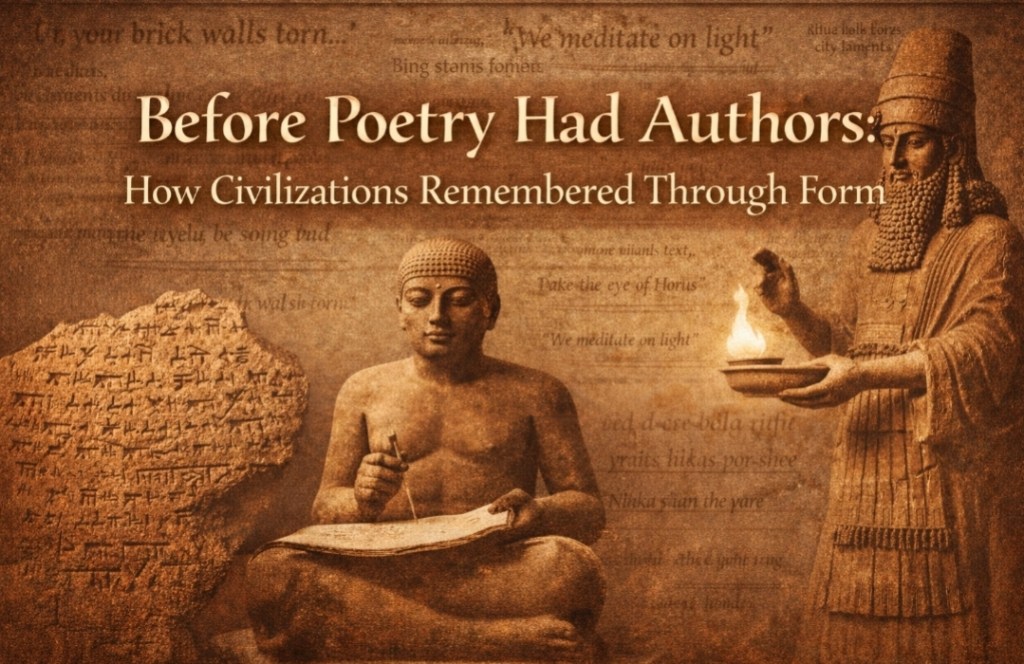
There was a time when poetry had no signatures.
No bylines.
No first-person confession.
No anxiety about originality.
A voice rose in the dark—at dawn, at funerals, at the fall of cities—and it mattered less who spoke than how precisely the words were spoken. Memory, not expression, was the point. Accuracy, not innovation, was the virtue. The survival of a people often depended on the faithful repetition of sound.
Long before poetry became literature, it functioned as something far more essential: a technology of remembrance.
This was poetry before authorship—when form itself carried civilization.
A World Without Poets
To imagine early poetry, we must first abandon the modern idea of the poet. There was no solitary figure shaping lines in private, no struggle with voice or originality. Instead, poetry lived in ritual spaces: temples, burial grounds, seasonal ceremonies, city squares after catastrophe.
The speakers were priests, chanters, seers, elders—roles defined by function, not personality. Their task was not to invent, but to transmit. Not to surprise, but to preserve.
In such cultures, a poem was successful only if it could be remembered exactly.
This requirement shaped everything. Words were chosen not for novelty, but for recall. Structure mattered more than sentiment. Rhythm mattered more than metaphor. Repetition was not redundancy—it was insurance.
Poetry did not belong to an individual. It belonged to time.
Why Early Poetry Was Anonymous by Design
The absence of authorship in early poetic traditions was not an accident of history. It was a design principle.
Authorship introduces variation. Variation threatens continuity.
In oral cultures, where no external archive existed, memory itself was the archive. The more stable the form, the more reliable the transmission. Anonymous poems were easier to trust because they were not tied to a single mind. They existed beyond ego and lifespan.
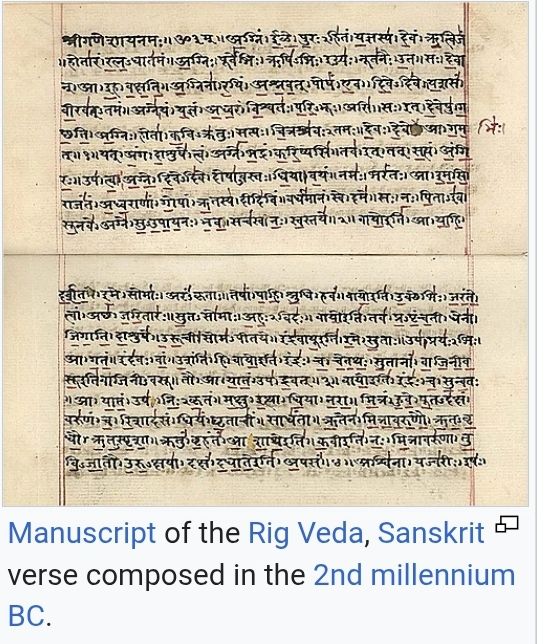
In ancient Mesopotamia, ritual laments for fallen cities followed strict structural patterns. In Vedic culture, hymns were attributed not to poets but to ṛṣis—seers who “heard” eternal truths rather than composed them. In Egypt, funerary spells were not creative works; they were instructions meant to function correctly in the afterlife.
A named author would have been a liability.
The poem had to outlive its speaker. That demanded discipline, not invention.
Form as Memory Technology
If we strip early poetry of its mystique, what remains is something remarkably practical: a system engineered for recall.
Form was not ornamental. It was operational.
Meter acted as a timing mechanism, guiding the body as much as the mind. Repetition created redundancy, catching errors before they could spread. Parallel structures allowed listeners to anticipate what came next, reinforcing memory through expectation. Formulaic phrases—stock epithets, recurring invocations—served as cognitive anchors.
These were not aesthetic choices. They were mnemonic solutions.
A twenty-line stanza repeated across generations ensured consistency. Fixed syllable counts prevented drift. Call-and-response structures distributed memory across a community rather than concentrating it in one person.
In effect, poetry functioned as a distributed storage system—robust, fault-tolerant, and remarkably durable.
Long before writing, civilizations learned to encode themselves in sound.
When Meaning Was Secondary to Structure
From a modern perspective, this can feel unsettling. We tend to treat meaning as the core of poetry. Yet in early traditions, meaning was often secondary to structure.
This does not mean that meaning was absent. It means that meaning was expected to remain flexible.
Languages shift. Pronunciations evolve. Religious interpretations change. What could not change was form.
A hymn might survive long after its original theology faded. A funerary spell might be recited by speakers who no longer understood every archaic word. Yet as long as the structure remained intact, the poem was considered alive.
Form was the vessel; meaning was the cargo. Cargo could be replaced. The vessel could not.
This explains why some ancient poems feel opaque today. We encounter perfectly preserved structures carrying meanings that no longer fully translate. What survives is the skeleton of memory.
Poetry as Civic Infrastructure
Early poetry did not exist for private reflection. It existed to hold societies together.
City laments were performed after destruction, naming loss in a communal voice. Funerary texts ensured the dead passed safely into the next world, stabilizing beliefs about death and continuity. Epic songs reinforced political legitimacy, tracing divine favor and ancestral right.
In this sense, poetry functioned as infrastructure.
It encoded law before legal codes. It preserved history before chronicles. It taught cosmology before philosophy. It coordinated emotional responses to catastrophe and change.
To forget a poem was not merely to lose art. It was to risk disorder.
Poetry was how civilizations remembered who they were.
The Role of Sound: When Poetry Was Music First
One of the most overlooked aspects of early poetry is its musicality. Many ancient poetic forms were inseparable from melody. Sound, not text, was the primary medium.
Scales, tonal systems, and rhythmic patterns reinforced memory through the body. The voice learned what the mind might forget. Chanting synchronized breath and attention, embedding verse in muscle memory.
This is why early poetry often feels resistant to silent reading. It was never meant to be seen. It was meant to be heard—and repeated.
Sound was not decoration. It was memory made audible.
Fragmentation and Extinction
Not all poetic traditions survived intact.
Some exist only in fragments—broken tablets, partial inscriptions, reconstructed melodies. Others vanished entirely, leaving no trace beyond indirect references. These losses were not random. They occurred when the conditions that sustained memory collapsed.
When rituals ended, forms decayed.
When communities dispersed, transmission broke.
When writing replaced performance too quickly, living systems froze and died.
Writing preserves words, but it often kills flexibility. A written poem cannot adapt to its speaker. It cannot self-correct through communal use. Once detached from ritual, it becomes static.
Many early poetic forms were not meant to survive without their social ecosystems.
Their extinction is a reminder: memory is not stored—it is practiced.
The Rise of the Author
At some point, the balance shifted.
Writing became widespread. Archives emerged. Memory externalized itself. Poetry no longer needed to carry civilization on its back.
With that shift came authorship.
The poetic “I” entered the scene. Voice became personal. Innovation became valued. Variation became a feature rather than a flaw.
This was not a decline. It was a transformation.
Yet something was lost in the process: the idea that poetry bears responsibility beyond expression. That a poem might exist not to reveal a self, but to safeguard a culture.
Modern poetry often asks, What do I feel?
Ancient poetry asked, What must not be forgotten?
Reading Poems Never Meant to Be Read
When we encounter ancient poetry today, we do so through fragments, translations, and scholarly reconstruction. We read silently what was once spoken aloud. We analyze what was once embodied.
This distance can make early poetry seem remote or austere. But that austerity is deceptive.
These poems were once alive in performance. They shaped breath, movement, and communal rhythm. They were not distant artifacts; they were events.
To read them now is to listen across time—to echoes of voices trained not in creativity, but in continuity.
Why This Still Matters
We live in an age of unprecedented textual abundance. Words are everywhere, endlessly produced and instantly forgotten. Memory has been outsourced to machines. Continuity feels fragile.
In such a world, the ancient relationship between poetry and memory feels newly relevant.
What would it mean to create words meant to last?
What structures would we choose if we expected them to survive us?
What deserves repetition?
Before poetry had authors, it had responsibility.
It existed not to express individuality, but to anchor humanity against forgetting. In remembering how civilizations once trusted form over ego, we may rediscover a quieter, deeper function of language itself.
Not everything must be new.
Some things must endure.
This post is part of the Bookish League blog hop hosted by Bohemian Bibliophile.


 Poetry Hub
Leave a reply to Tulika Cancel reply