The Places That Do Not Exist—Yet Live in Us
Think about a place that has never appeared on any map.
A town you cannot visit. A street that belongs to no country. A quiet hillside that exists only between the pages of a book.
Yet you remember it.
You remember the air there, the light, the strange familiarity of walking through it as if you had been there before.
Readers experience this quiet paradox every day. Fiction invents locations, but memory treats them as real. The mind stores them not as inventions but as emotional coordinates.
This is the hidden geography of literature—the landscapes that exist somewhere between imagination and memory.
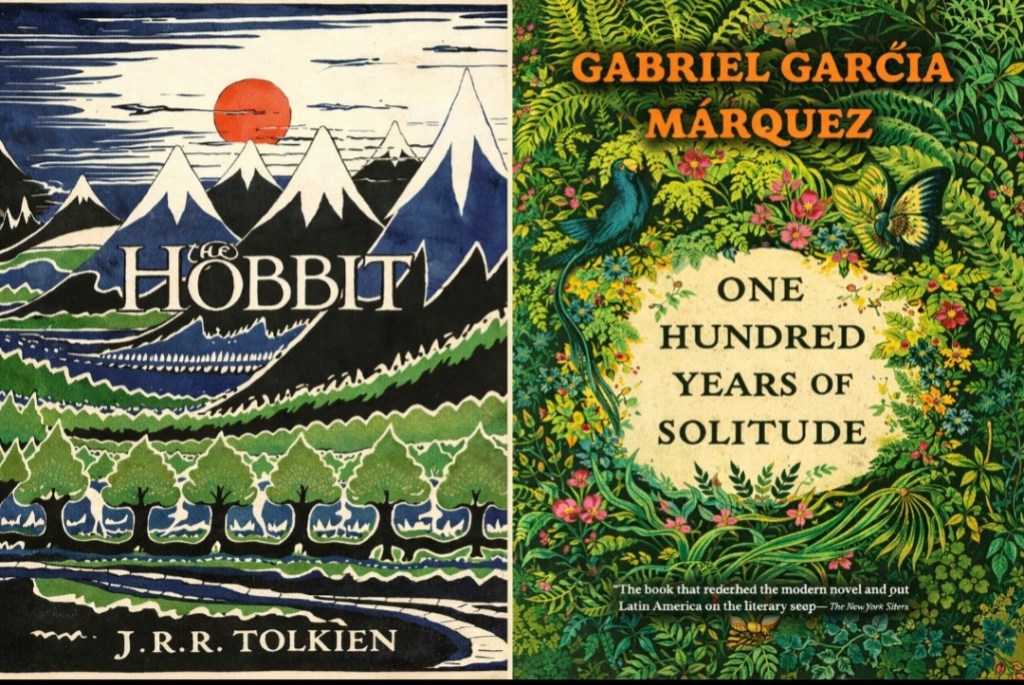
In the fictional town of Macondo from One Hundred Years of Solitude, rain can fall for years, ghosts sit in kitchens, and time bends like a slow river. The place is impossible, yet millions of readers remember it vividly.
Similarly, Middle-earth from The Hobbit is more than a fantasy setting. It feels mapped into the reader’s emotional memory: the warmth of the Shire, the cold edges of distant mountains, the sense of journey stretching beyond the horizon.
What these stories reveal is something subtle but profound:
Fiction does not merely describe places.
It builds landscapes inside the reader’s memory.
Memory Is Not a Map
Real geography relies on precision.
Maps require coordinates, distances, borders, and measurable terrain. But the geography of memory works differently. It bends space around emotion.
When readers recall a fictional place, they rarely remember its exact layout. Instead, they remember how it felt.
A village might represent safety.
A forest might hold mystery.
A city might symbolize longing.
The emotional experience becomes the landmark.
This is why two readers can remember the same fictional place differently. The landscape remains the same in the text, but memory reshapes it according to each reader’s inner life.
Literature quietly invites this transformation.
Every description is incomplete on purpose. Writers leave space for readers to build the world themselves.
The result is not a shared map—but a shared emotional territory.
The Architecture of Imaginary Places
Great fictional worlds often follow a hidden structure.
They mirror the psychological journeys of the characters who move through them.
The Shire in The Hobbit represents stability and innocence. As the story unfolds, the landscape becomes darker and more uncertain, reflecting the protagonist’s transformation.
The geography becomes emotional architecture.
Similarly, Macondo in One Hundred Years of Solitude evolves across generations. The town expands, decays, remembers, and forgets. It behaves less like a setting and more like a living organism shaped by memory.
In both cases, geography does not merely support the story.
It becomes the story.
Readers do not simply observe these places. They inhabit them.
Why Fictional Places Feel Real
There is a reason readers often feel nostalgic for places they have never visited.
The brain processes imagined experiences in ways surprisingly similar to real ones. When readers visualize a location vividly enough, memory stores fragments of that experience.
Over time, the distinction between imagined and remembered space begins to blur.
This is why people sometimes speak of fictional worlds as if they were once there.
“I remember that forest.”
“I remember that house.”
“I remember that road.”
The language of memory quietly replaces the language of imagination.
Stories transform invented landscapes into psychological memory spaces.
The Reader as Cartographer
Every reader becomes an unconscious mapmaker.
As a story unfolds, the mind sketches invisible routes:
The path a character walks each morning.
The room where a crucial conversation occurs.
The river crossing that marks a turning point.
None of these maps exist in the book itself. They form gradually in the reader’s imagination.
This process explains why adaptations of beloved novels often feel surprising or even unsettling. The visual version rarely matches the private geography readers have built for themselves.
Each reader carries a different version of the same world.
Literature does not create a single landscape.
It creates millions of personal ones.
Places That Remember
Some fictional places seem to remember their inhabitants.
The atmosphere changes after certain events. Rooms carry emotional residue. Streets hold echoes of past conversations.
These subtle details transform locations into emotional archives.
A quiet house can hold grief.
A town square can remember celebration.
A deserted road can carry the shadow of departure.
These moments give fictional geography depth.
Places stop being passive backdrops and begin acting like memory itself—layered, imperfect, and alive.
Why These Places Stay With Us
Long after a story ends, readers often remember its locations more vividly than its plot.
The reason is simple.
Plot moves forward, but place lingers.
A character’s journey eventually concludes, but the place where it happened remains suspended in imagination. Readers can revisit it whenever they return to the story.
Over time, these places begin to feel strangely personal.
They become part of the reader’s internal landscape.
A childhood reader might still remember the quiet warmth of the Shire decades later. Another reader might carry Macondo like a dream that refuses to fade.
These fictional geographies slowly blend with the geography of real life.
The Quiet Power of Literary Landscapes
Perhaps the most remarkable aspect of fictional geography is how gently it works.
Stories rarely announce that they are building worlds inside readers. The process happens quietly, page by page.
A description of a road.
A glimpse of a house.
A passing mention of a distant hill.
Piece by piece, these fragments assemble themselves into a place that begins to feel permanent.
Years later, readers may forget details of the narrative. But the landscape remains.
Conclusion: The Places We Carry
Every reader carries a private atlas.
It contains places that cannot be located on any physical map: villages from childhood stories, forests encountered in novels, cities imagined through poetry.
These landscapes belong to literature, yet they also belong to memory.
They exist somewhere between imagination and experience.
When readers open a beloved book again, they do not simply revisit a story.
They return to a place they have already lived in their mind.
And in that quiet moment, fiction reveals one of its most enduring powers:
Stories do not just create characters.
They create places we remember forever.
Which fictional place has stayed with you long after you finished the book—and why do you think it feels so real in your memory?


 Between Stars & Silence
Leave a reply to Swamigalkodi Astrology Cancel reply