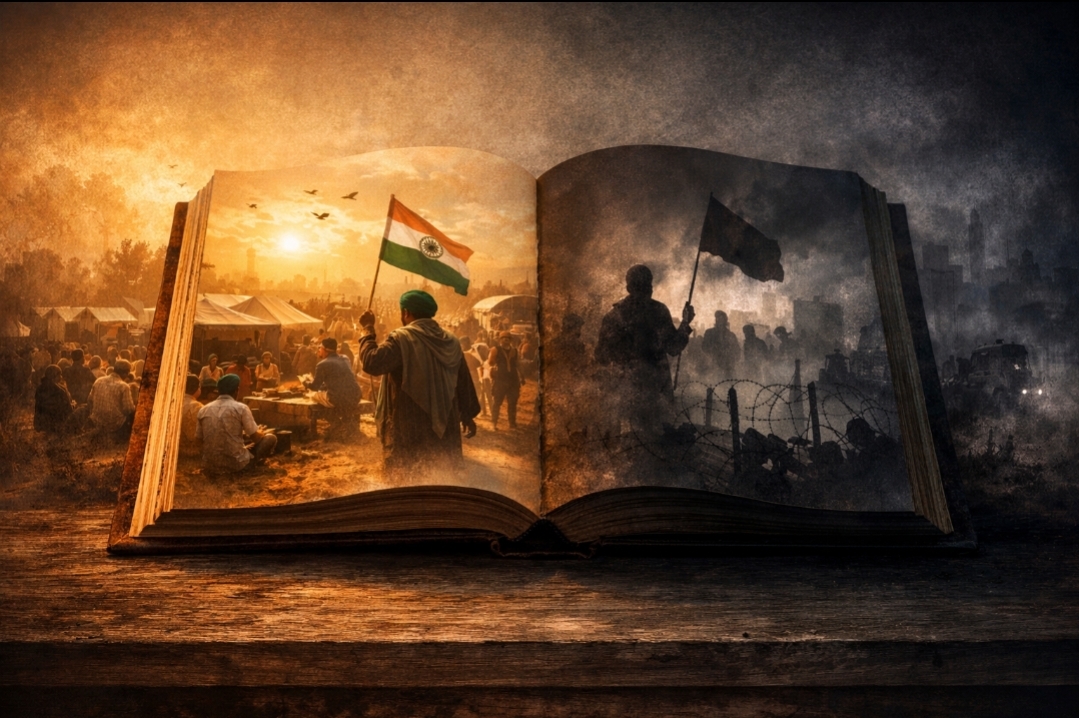
The Mirage of Monochrome Narratives
In the grand theatre of history, truth rarely arrives in black and white; it moves instead through the subtle gradients of competing voices, forgotten facts, and inconvenient realities. Ancient Indian wisdom, from the Vedas to Kautilya’s Arthashastra, cautions against ekanta-vada—the danger of one-sided arguments that fracture the wholeness of truth. Yet, in an increasingly polarized age, narratives often succumb to simplification, flattening complexity into certainty.
It is within this landscape that Sudhir Kumar Suthar’s Farmer Power: The 2020–21 Movement, the State and Agricultural Reforms in India emerges. Positioned as an academic examination of one of India’s most consequential protest movements, the book promises analytical depth and historical clarity. What it offers, however, is something more selective—a narrative that privileges conviction over contradiction, and in doing so, risks reinforcing a singular lens over a profoundly multifaceted reality.
For readers seeking a balanced understanding of a defining moment in contemporary India, the work may illuminate certain truths—but leave others in shadow.
“Truth rarely arrives in black and white; it moves through the uneasy terrain of competing voices and silences.”
The Book
Published in November 2025 by Penguin Random House India, Farmer Power arrives in the aftermath of a movement that reshaped national discourse around agriculture, governance, and dissent. Its author, Sudhir Kumar Suthar, an Assistant Professor at the Centre for Political Studies at Jawaharlal Nehru University, brings with him a strong academic background in political science, with prior research focused on agrarian distress, farmer suicides, and public policy.
The book positions itself as a rigorous chronicle of the 2020–21 farmer protests—movements that mobilized large sections of India’s agrarian population against three contentious farm laws. It promises to explore not just the protests themselves, but their broader implications for democracy, state power, and rural citizenship.
Endorsements from academic circles describe it as a “unique chronicle” and a study of “democracy from below.” These descriptors set high expectations: that the book will move beyond surface narratives and offer a layered, balanced interpretation of events that were as complex as they were consequential.
Yet, the intellectual environment from which the book emerges—often associated with strong critiques of state policy and neoliberal reforms—appears to shape its narrative direction in discernible ways. This does not invalidate the work, but it does frame the lens through which its arguments unfold.
“What appears as a definitive account often reveals itself, upon closer reading, as a carefully framed perspective.”
Central Ideas
Structurally, Farmer Power unfolds through a chronological and thematic progression. It begins by situating the protests within a broader history of agrarian distress—highlighting issues such as fragmented landholdings, limitations of the Minimum Support Price (MSP) system, and the enduring crisis of farmer indebtedness.
From this foundation, the book transitions into a critique of the 2020 farm laws, presenting them as a decisive shift toward market-driven agriculture. These reforms are framed not merely as policy changes, but as existential threats to “food sovereignty” and rural autonomy.
The central chapters focus on the protests themselves. Here, the narrative becomes most vivid and emotionally resonant. The mobilization of farmers—particularly from Punjab and Haryana—is portrayed as a remarkable exercise in collective resistance. The protest sites at Delhi’s borders are described as spaces of resilience and solidarity, sustained through community kitchens, shared labor, and a sense of shared purpose that, the book suggests, transcended traditional divisions of caste and class.
The state’s response is interpreted through a critical lens, emphasizing strategies of delegitimization—ranging from media narratives to political framing. The protests are positioned as a democratic counterforce, embodying “power from below” and challenging centralized authority.
The conclusion frames the repeal of the farm laws in November 2021 as a “spectacular victory,” underscoring the capacity of collective action to influence state policy.
Yet, while this framework is internally coherent, it is also notably selective. Alternative perspectives—particularly those that engage with the potential benefits of reform, such as expanded market access or structural modernization—receive limited attention. Similarly, data points and policy arguments that complicate the narrative are often underrepresented or absent.
“Sincerity without scrutiny does not illuminate truth—it reshapes it.”
Reader Experience and Emotional Impact
The reading experience of Farmer Power is marked by a distinct duality. On one hand, the book succeeds in evoking empathy. Its descriptive passages bring the protest sites to life—the harsh winters endured at border encampments, the rhythms of communal kitchens, the quiet resilience of individuals who left their homes in pursuit of a collective cause.
These moments create a strong emotional connection with the protesters, transforming them from abstract political actors into lived human experiences.
Yet, this emotional immersion is accompanied by a narrowing of perspective. The state is often rendered as a singular, monolithic force, while the complexities within the protesting community itself receive less sustained attention. Divergent farmer voices—particularly those from regions or groups that viewed the reforms differently—remain largely peripheral.
For readers attuned to the broader socio-economic ripple effects of the protests, this can create a sense of imbalance. The disruptions to supply chains, the economic consequences for urban and migrant populations, and the varied responses across India’s diverse agrarian landscape are not explored with comparable depth.
As a result, the emotional arc of the book feels directed—guiding the reader toward a particular interpretation rather than inviting them into a space of open inquiry. The narrative culminates in a sense of triumph, yet leaves certain questions unresolved, particularly regarding the long-term implications of both the protests and the policy reversals that followed.
“To tell only one side of a story, however compelling, is to risk mistaking a fragment for the whole.”
Critical Reflections
The limitations of Farmer Power become more apparent when examined through a critical lens.
Authorial Perspective:
Suthar’s academic background and prior work suggest a consistent engagement with critiques of state policy and market-oriented reforms. This intellectual orientation informs the book’s narrative, shaping both its emphases and its omissions. While such a perspective is valuable, its dominance within the text reduces the presence of countervailing viewpoints.
Structural Selectivity:
Across its chapters, the book tends to foreground certain dimensions of the protests while minimizing others. The organizational strength and solidarity of the movement are explored in detail, but internal tensions—whether along lines of caste, region, or political affiliation—receive less attention. Similarly, the state’s actions are often framed in terms of control and delegitimization, with limited exploration of dialogue, negotiation, or policy rationale.
Gaps in Contextual Balance:
The broader policy landscape surrounding the farm laws is not fully developed. Arguments in favor of reform—such as the need to address inefficiencies in agricultural markets or to expand opportunities beyond traditional mandis—are acknowledged only briefly, if at all. This absence limits the reader’s ability to engage with the full spectrum of debate.
Narrative Framing:
Perhaps most significantly, the book constructs a dichotomy between virtuous resistance and problematic authority. While this framing enhances narrative clarity, it also simplifies a reality that was far more complex. Movements of this scale inevitably contain contradictions, competing interests, and unintended consequences—elements that remain underexplored.
In this sense, Farmer Power functions less as a comprehensive analysis and more as a deeply committed interpretation—one that privileges coherence over complexity.
“The power of narrative lies not only in what it reveals, but in what it chooses to leave unsaid.”

My Final Contemplative Insight
Farmer Power is not without merit. It captures, with sincerity and detail, the lived experience of a historic movement. It gives voice to concerns that are real and deeply felt. Yet, sincerity alone does not guarantee completeness.
In a democracy as layered as India’s, truth is rarely singular. It emerges through dialogue, through friction, through the coexistence of perspectives that do not easily reconcile. To tell only one side of a story—no matter how compelling—is to risk mistaking part for whole.
What this book ultimately reveals is not just the story of a protest, but the challenge of narrating it. It reminds us that every account is shaped by the vantage point from which it is written—and that the responsibility of the reader is not merely to absorb, but to question.
Perhaps the deeper lesson lies here: that understanding is not found in choosing between narratives, but in holding them together, however uneasily, until a more complete picture begins to emerge.
Until then, the story of India’s farmers—like all stories that matter—remains unfinished, waiting for voices that can embrace its full, unquiet complexity.
“In the absence of complexity, even the most passionate storytelling can become a quiet form of distortion.”

Leave a Reply