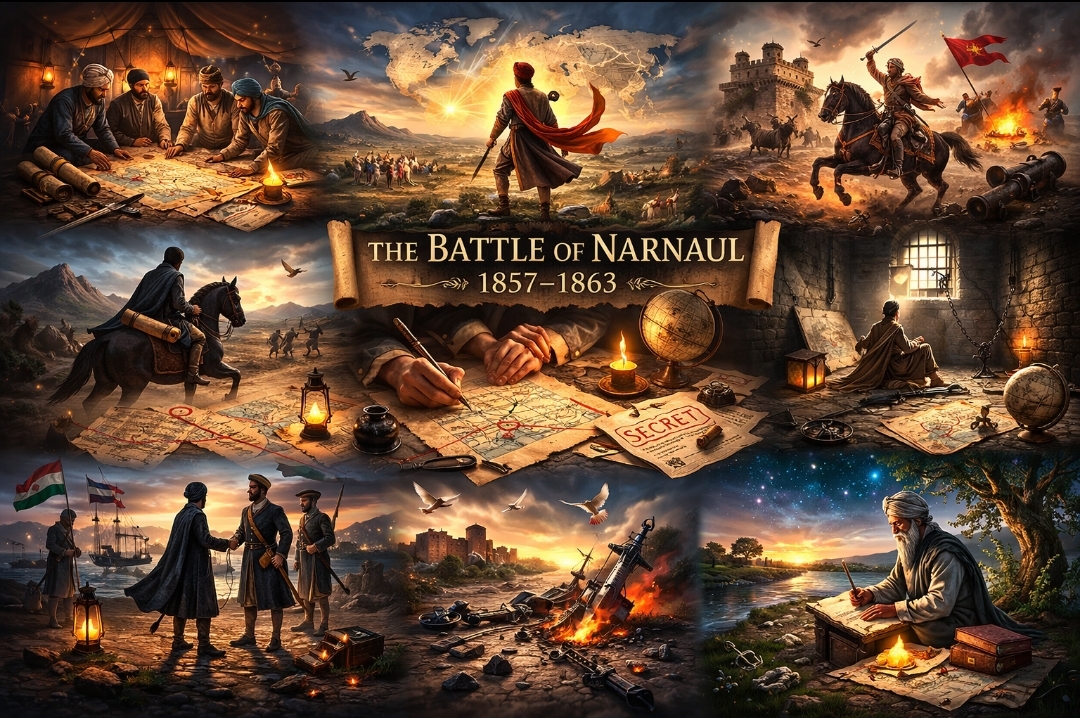
History often arrives to us like a completed sky—constellations already named, their patterns fixed, their meanings agreed upon across generations. We inherit these shapes as truth, rarely pausing to ask what stars were left uncharted, what faint lights went unnoticed, what stories dissolved before they could be spoken.
And yet, every so often, a work emerges that unsettles this inherited stillness.
“Resistance is not only defiance—it is imagination under constraint.”
The Battle of Narnaul: Rao Tula Ram’s Secret Global Plot to Overthrow the British 1857–1863 by Kulpreet Yadav and Madhur Rao does not merely recount an episode from the past; it opens a fissure within it. It asks us to reconsider not just what happened, but what might have been unfolding beneath the surface—quietly, deliberately, almost invisibly.
At its center stands Rao Tula Ram—not simply as a historical figure, but as a presence moving through the uncertain terrain between resistance and vision. The book frames him not as a solitary rebel confined to a regional struggle, but as a thinker of wider horizons, someone who understood that power was not only local, and therefore resistance could not remain so either.
This shift in perspective is subtle yet profound.
It transforms the idea of rebellion from a reactive impulse into something far more complex—an act of imagination. To resist, in this telling, is not only to oppose what exists, but to conceive of alternatives that do not yet have form. It is to see beyond the visible edges of one’s world and to act as though those unseen connections already matter.
“History remembers selectively; silence is its most eloquent omission.”
In this sense, the battlefield of Narnaul becomes something more than a site of conflict. It becomes a point of convergence—a place where different possible futures brush against one another, where intent stretches further than circumstance allows.
The narrative moves through this space with a certain quiet intensity. It does not rush toward conclusions. Instead, it lingers in the idea that history, as we receive it, is often a reduction—a narrowing of events into outcomes, of possibilities into certainties.
What the authors attempt here is an expansion.
They gesture toward a network of efforts and aspirations that extend beyond the familiar contours of 1857, suggesting that resistance may have been more globally imagined than traditionally acknowledged. There is an almost gravitational pull in this idea—the sense that beneath the documented surface, there existed currents of thought and strategy that reached outward, seeking alignment across distances.
And yet, this expansion introduces its own tension.
For where the archive falls silent, interpretation must begin.
At times, the narrative leans into reconstruction, asking the reader to inhabit a space where evidence and inference intermingle. For some, this may feel like a stretching of historical boundaries; for others, it may feel like a necessary act of recovery—an attempt to restore dimension to a past flattened by selective memory.
This tension is not easily resolved.
But perhaps it is not meant to be.
For history itself is not a complete map. It is, at best, a fragmentary constellation—its brightest stars visible, its dimmer ones often overlooked. To engage with it deeply is to accept this incompleteness, to recognize that certainty is often constructed rather than discovered.
“Not all battles end—some continue as questions.”
Reading this book, one becomes aware of this incompleteness not as a limitation, but as an opening.
There are moments of quiet wonder—when the scale of what is being suggested begins to take shape. The idea that resistance could think globally, could attempt to weave connections across borders and empires, introduces a sense of magnitude that challenges familiar narratives.
At the same time, there is a certain distance.
The inner life of its central figure remains partially obscured. We encounter his actions, his movements, his intentions—but less often his doubts, his hesitations, his private reckonings. The emotional terrain, while present, does not fully unfold. It is as though we are walking beside him, but not entirely within him.
And yet, even in this distance, something resonates.
Perhaps because the book’s true subject is not only a man or a battle, but a condition—the condition of striving within constraint.
There is a quiet recognition that runs beneath the narrative: that human beings have always lived within structures they did not choose, and yet have always attempted to exceed them. Sometimes through action, sometimes through thought, sometimes through vision alone.
“What almost happened shapes us as much as what did.”
Not all such attempts succeed.
Most, perhaps, do not.
But failure, in this context, does not erase significance. It alters its form.
An unrealized alliance, a disrupted plan, a vision that could not fully manifest—these do not disappear. They remain, not as events, but as possibilities that once existed. And in that existence, however brief, they expand the horizon of what was thinkable.
This is where the book begins to move beyond history and into philosophy.
It invites us to consider that the past is not only a record of what was achieved, but also a repository of what was attempted. That meaning does not reside solely in outcomes, but in the very act of reaching beyond what seems possible.
In a world that often measures value through visible success, this is a quietly radical idea.
It suggests that intention matters.
That effort carries its own weight.
That even within overwhelming systems, the act of imagining differently is itself a form of resistance.
There is also, within this narrative, a meditation on memory.
Who decides what is remembered?
What determines which stories endure and which dissolve?
And what happens to those that remain incomplete?
The book does not offer definitive answers. Instead, it leaves the reader in a space of reflection—a space where certainty gives way to inquiry.
Perhaps that is its most enduring quality.
It does not close the past; it reopens it.
Like a river whose surface appears calm but whose depths carry unseen currents, the narrative moves quietly, persistently, suggesting that beneath every established account lies another layer—waiting not to be proven entirely, but to be considered.
And in engaging with that layer, we are changed—not because we arrive at a new conclusion, but because we begin to see differently.
“To read history deeply is to doubt its completeness.”
For reading, at its deepest, is not an act of accumulation.
It is an act of reorientation.
We enter a text seeking knowledge, but we leave it with altered questions.

And perhaps that is what this book ultimately offers—not a definitive rewriting of history, but a gentle, insistent reminder that history itself is never fully written.
It remains, always, in motion.
Like the wind that crosses unseen borders,
like the stars that continue to burn beyond our naming,
like the quiet, persistent human impulse
to imagine a world
that does not yet exist.
Perhaps the deepest gift of such a book is not in what it tells us about the past, but in what it reveals about our way of seeing. To read is not merely to gather knowledge—it is to encounter the limits of what can be known. And in that encounter, we are reminded that life itself is not a completed narrative, but an unfolding one—shaped as much by silence, possibility, and imagination as by what is already written.

Leave a Reply