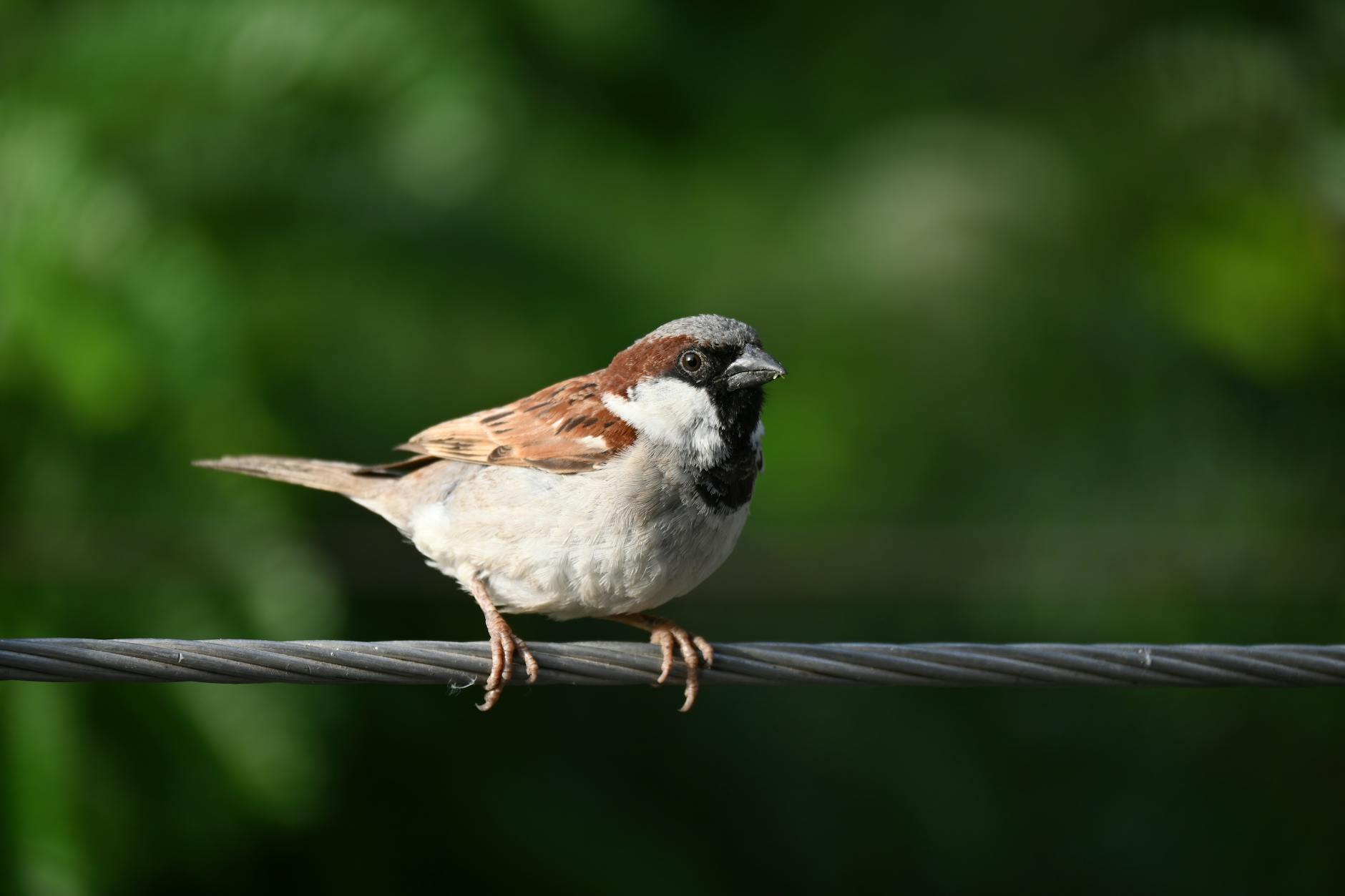
Where have the sparrows gone is a question that begins in the natural world but echoes far deeper within us. Once a familiar presence in everyday life, sparrows lived quietly alongside us—on windowsills, in courtyards, in the unnoticed spaces we rarely questioned. Their gradual disappearance is often explained through science and urban change, yet it also reflects a subtler loss.
This poem explores that layered absence—ecological, emotional, and philosophical. It moves through memory and modernity, examining how progress has reshaped not only our environments but also our inner landscapes. In asking where have the sparrows gone, we are also confronting a quieter realization: that something gentle, attentive, and essential within us may have faded alongside them.
Where Have the Sparrows Gone

Where have the sparrows gone—
the small, unannounced keepers of morning?
Once they stitched the air
with fragile threads of sound,
soft as breath,
persistent as light entering a quiet room.

They asked for nothing—
no monument, no memory—
only a ledge,
a crack in the wall,
a little unnoticed corner
to call a world.

And yet, they are gone.

Not suddenly,
not like storms that declare their arrival,
but like childhood—
slipping quietly out of the back door
while we were busy growing up.

Where have the sparrows gone—
and with them,
those afternoons that stretched without purpose,
those windows left open
not for air-conditioning
but for air itself?

We have explanations now.
Precise, measurable,
comfortably distant.

The air is heavier—
laced with things that cannot be seen
but can be felt
in lungs that forget how to be light.

The fields are quieter—
not with peace,
but with absence—
for the insects have vanished,
and hunger has learned a new shape.

Signals fill the sky—
invisible currents
we celebrate as connection,
yet perhaps
they whisper confusion
into the delicate maps
that once guided wings home.

We have built upward,
and called it progress.
Walls without memory,
glass without invitation.

No cracks,
no ledges,
no forgiveness
for something small
to belong.

Where have the sparrows gone—
in this geometry of perfection?

Even the trees seem fewer,
as though the earth itself
has been persuaded
to stand still
and not reach out anymore.

And in their absence,
others arrive—
stronger voices,
sharper beaks,
better suited
to this new arithmetic of survival.

It is not cruelty.
It is simply
what happens
when balance forgets itself.

Yet something deeper unsettles—

For the question is no longer
only ecological.

It leans inward.

Where have the sparrows gone
inside us?

Where is that small,
unremarkable joy
that required no achievement?

Where is that attention
that rested easily
on the ordinary miracle
of a bird hopping twice
and then taking flight?

We have replaced it
with urgency,
with the constant rehearsal of importance,
with lives measured
not in presence
but in acceleration.

Even silence has changed.

It is no longer a space
that holds us—
it is something we rush to fill.

But once,
there were mornings
when silence was shared—
not empty,
but inhabited
by sparrows.

And in that quiet companionship,
something within us
remained whole.

Where have the sparrows gone—
the question repeats,
not seeking an answer
but revealing a wound.

For their disappearance
is not an event.

It is a message.

That the web has loosened.
That the threads are thinning.
That life, in its quiet agreements,
is being renegotiated
without our awareness.

And perhaps,
without their small, persistent presence,
we have forgotten
how to notice
what does not demand attention.

There is a passage
in an old remembering—
that not one sparrow falls
without being seen.

And yet now,
their absence stretches wide,
unnoticed by the many,
felt only by the few
who still remember
how mornings once sounded.

Where have the sparrows gone—
into statistics,
into reports,
into footnotes of concern?

Or have they simply withdrawn
from a world
that no longer knows
how to receive them?

And if they return—
if one morning
a single, hesitant chirp
breaks through the machinery of dawn—

Will we hear it?

Or has something within us
grown too distant,
too conditioned to noise,
to recognize
the language of small things?

Perhaps this is the deeper asking—

Not where have the sparrows gone,
but whether we are still here
in the way we once were.

For they belonged
not only to the world
but to a way of seeing it—

A way that did not separate
utility from wonder,
or existence from meaning.

And so the sky remains,
wide, patient,
holding both absence
and possibility.

The buildings stand,
certain of themselves.

The signals move,
restless, unceasing.

But somewhere,
in a quieter rhythm
beneath all this becoming,
life still remembers
how to begin again.

And perhaps,
if we learn once more
to leave a small space unclaimed,
to listen without seeking,
to allow the ordinary
to arrive without purpose—

The sparrows may return.

Or something like them.

And with them,
not just birds—

But the soft,
unmeasured presence
of a life
that does not hurry
to become something else.

Until then,
the question remains—

Where have the sparrows gone?

And what,
in their quiet leaving,
have we allowed
to disappear within ourselves?

Reflections
At its core, where have the sparrows gone functions as both an environmental observation and a philosophical inquiry. Scientifically, their decline points to habitat loss, pollution, and ecological imbalance. Yet the poem deliberately extends beyond these causes to examine a parallel human shift.
Sparrows symbolize the unnoticed—small presences that once grounded daily life in quiet continuity. Their absence reflects a broader transformation: from stillness to speed, from attention to distraction, from coexistence to control. The modern environment, optimized for efficiency and growth, often leaves little room for what is subtle, fragile, and unassertive.
The poem suggests that this loss is not confined to the external world. It is mirrored internally, in the diminishing capacity to pause, observe, and find meaning in the ordinary. In this sense, ecological decline and inner disconnection are not separate phenomena but interlinked expressions of the same imbalance.
Rather than offering resolution, the poem invites recognition. It asks whether restoration—of nature or of self—begins simply by noticing what we have stopped seeing.

Leave a Reply