“Desire’s deepest form is its absence.”
In the quiet swell of the waxing moon on Chaitra Trayodashi, something subtle begins to stir. Anang Trayodashi is not merely a ritual observance—it is an inward turning, a philosophical encounter with one of life’s most enduring paradoxes: that desire, when stripped of form, does not disappear—it deepens.
The myth offers a mirror.
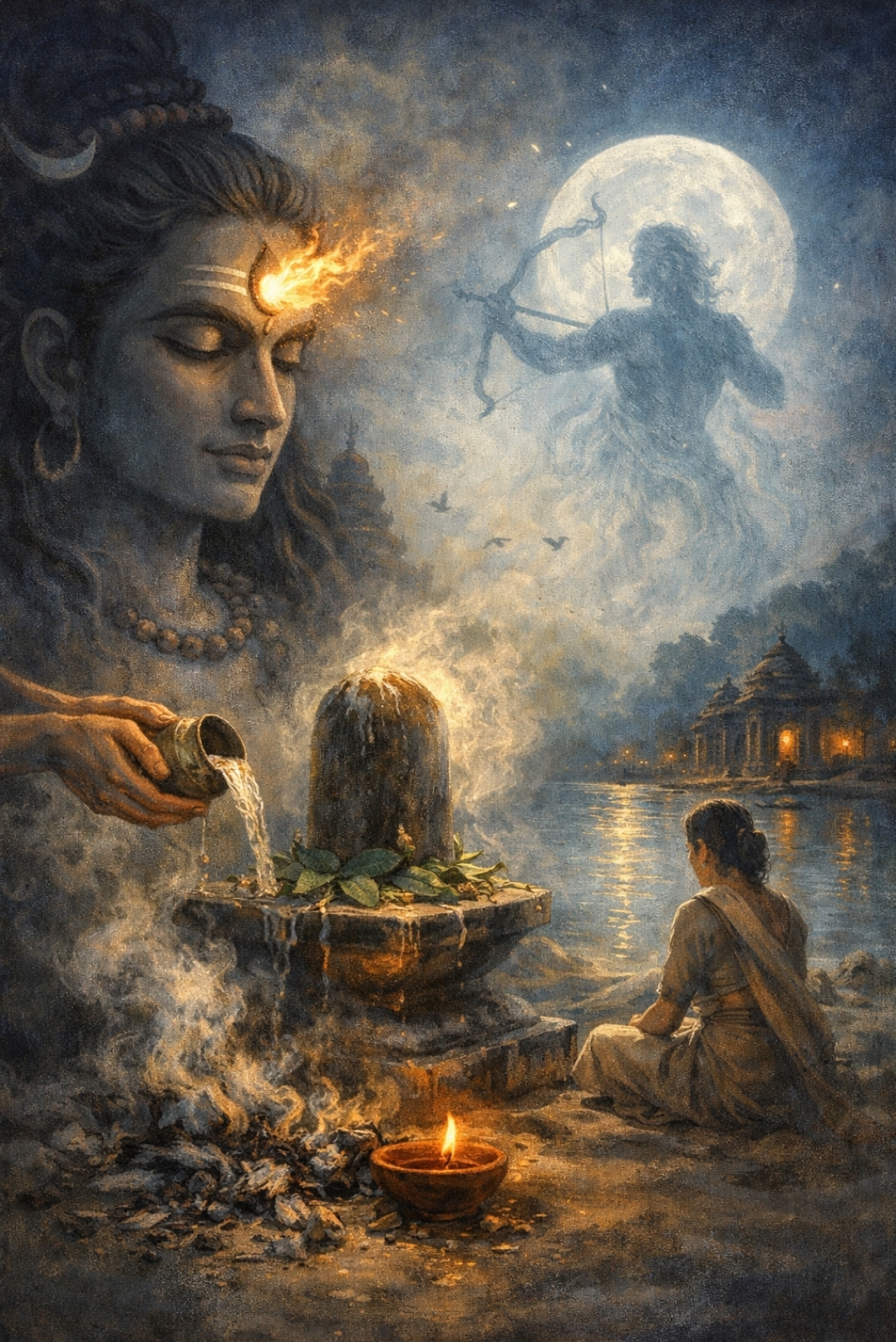
Kamadeva, the god of desire, dares to interrupt Shiva’s stillness. His arrow flies—not as aggression, but as awakening. Yet, in a moment that defines the human condition, Shiva opens his third eye, and desire is reduced to ash. What remains is not absence, but transformation. Kamadeva returns—not in body, but as Anang—the formless one, sustained through Rati’s unwavering devotion.
This is not mythology alone. It is the pattern we live.
Why is it that what we long for most often dissolves just as we reach for it? Why do relationships fracture, passions fade, and dreams lose their contours? We experience the burning, but rarely the becoming. We grieve the loss of form, unaware that something more expansive has quietly taken its place.
Anang Trayodashi asks us to pause within this tension.
The vrat—marked by fasting, restraint, and inward focus—is not denial. It is a deliberate hollowing. In abstaining from food and physical indulgence, one does not suppress desire but allows it to shed its outer layers. The ritual of offering jaggery water over the Shivling, the stillness of belpatra placed with care—these are not acts of devotion alone, but gestures of surrender.
“Shiva burns to reveal, never to destroy.”
In lived experience, this is rarely dramatic.
It is the spouse who, after a quiet quarrel, returns not with words, but with presence—fingers tracing the edges of an altar, as if seeking alignment beyond language. It is the solitary devotee circling a modest shrine, where loneliness, instead of tightening, begins to dissolve into something vast and unnameable.
Nothing outward changes. Yet something within loosens.
The breath deepens. The need to resolve fades. The experience shifts—not from lack to openness.
And still, questions arise.
The Seeker asks:
“If desire is burned, why does it return stronger?”
The Observer responds:
“Because what burns is not desire itself, but its attachment to form.”
The Experiencer does not answer.
It simply feels the quiet persistence of something that refuses to vanish.
From this space, insights do not arrive as teachings, but as recognitions:
Desire survives its own destruction.
What we lose is not longing, but its object. The warmth that remains after loss is often overlooked, mistaken for memory rather than presence. Yet it is this residue that reveals desire’s deeper nature.
“In fasting’s void, love expands unbound.”
Formlessness expands desire’s reach.
When desire is no longer tied to a single form, it becomes diffuse, subtle, and pervasive. In a world saturated with images and immediacy, this quiet expansion often goes unnoticed—yet it is what allows love to move beyond possession.
Shiva’s gaze is not wrath—it is clarity.
The burning is not punishment, but revelation. What dissolves are illusions—the expectations, projections, and narratives we attach to desire. What remains is something unadorned and real.
“Union is surrender’s quiet flame.”
Devotion sustains what form cannot.
Rati’s waiting is not passive—it is a deep alignment with what cannot be seen. In a culture of immediacy, this kind of patience feels unnatural, yet it is what allows the invisible to endure.
Union is not achieved—it is allowed.
In moments of shared stillness—during a quiet prayer, a synchronized silence—separation softens. Not because differences disappear, but because the need to assert them does.

These insights do not remain confined to ritual—they ripple outward.
Human nature reveals itself as a constant reaching toward the intangible. We chase forms—people, achievements, identities—believing they will anchor what we feel within. Yet the more tightly we grasp, the more fragile those forms become.
In today’s world, this tension is amplified. Endless distractions simulate connection while deepening isolation. We scroll through curated fragments of life, mistaking visibility for intimacy. In this landscape, Anang Trayodashi becomes more than a tradition—it becomes a quiet resistance.
It reminds us that what is most real cannot always be seen.
Relationships begin to shift under this awareness. What once felt like a battleground of expectations softens into a shared space of presence. Identity, too, loosens—no longer rigidly defined by roles or narratives, but experienced as something fluid, responsive, alive.
Awareness does not eliminate desire—it refines it.
“What stirs in you, formless and alive?”
As this awareness deepens, the world itself changes texture. The urgency to acquire gives way to the willingness to experience. Control relaxes into participation. Love, no longer confined to form, begins to move more freely—less as possession, more as presence.
As Anang Trayodashi fades, it does not conclude—it lingers.
Not as ritual, but as residue.
Sit with the ash.
Not as absence,
but as something that no longer needs a shape to remain.

Leave a Reply