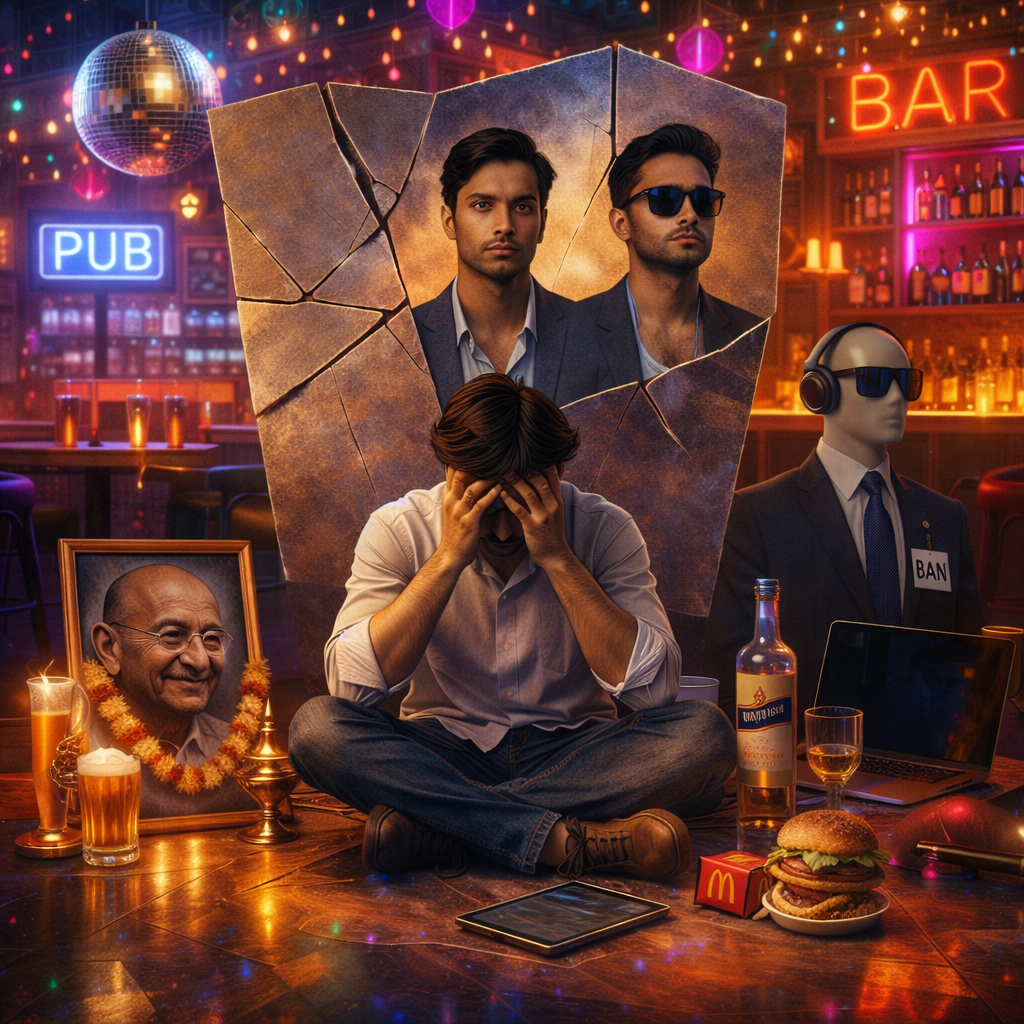
There is a quiet shift happening in identity crisis in modern India—one that doesn’t make headlines, yet shapes millions of lives every day.
The Quiet Fracture Within
There is a peculiar kind of confusion that does not announce itself loudly.
It does not arrive as a crisis in the conventional sense. There are no visible breakdowns, no dramatic turning points. Instead, it exists quietly—like a background noise that never quite fades. A subtle unease. A sense that something about who we are does not fully align with how we are living.
In modern India, this feeling is becoming increasingly familiar.
We move through our lives fulfilling roles, meeting expectations, adapting to change. And yet, somewhere beneath all of it, a question lingers—persistent, unresolved:
Am I becoming who I truly am, or simply who I am expected to be?
Somewhere between inheritance and choice, identity begins to feel less like a certainty and more like a question.
The Invisible Weight of Inheritance
Before we begin to define ourselves, much of our identity is already defined for us.
We inherit ways of thinking, patterns of behavior, cultural values, and unspoken expectations. Family, community, language, tradition—these are not merely influences; they are foundations. They shape how we see the world long before we become aware that we are seeing it at all.
In India, this inheritance is particularly dense.
Identity is rarely just individual. It is layered—family identity, social identity, cultural identity, sometimes even generational expectations carried forward without question. To belong is to align with these layers, often without consciously choosing them.
And for a long time, this alignment provides stability. It offers clarity. It answers the question of who we are without requiring us to ask it.
But something begins to shift when the world around us changes faster than the identities we have inherited.
Modern India as a Space of Contradiction
Modern India is not just evolving—it is expanding in multiple directions at once.
On one hand, there is unprecedented access to ideas, opportunities, and ways of living. Individual expression is encouraged. Independence is valued. The language of self-discovery is more visible than ever before.
On the other hand, deeply rooted structures of belonging remain intact. Family expectations, social norms, and cultural continuity still exert a quiet but powerful influence.
This creates a subtle but persistent contradiction.
We are told to think for ourselves, but also to remain aligned.
To explore, but not too far.
To become, but not at the cost of belonging.
We are learning to move forward, but often with one part of ourselves still anchored in the past.
This is not a conflict that can be easily resolved. It is not even always consciously recognized. But it is deeply felt.
And over time, it begins to shape how we experience ourselves.
The Inner Fragmentation
The most significant impact of this tension is not external—it is internal.
We begin to develop multiple versions of ourselves.
There is the self we present in professional spaces—confident, modern, adaptive.
The self we embody within family—respectful, aligned, rooted.
And then there is the private self—the one that holds questions, doubts, contradictions.
These selves do not always conflict openly. Often, they coexist. But their coexistence requires constant adjustment, constant negotiation.
Over time, this can lead to a subtle fragmentation.
Not a complete loss of identity, but a diffusion of it.
It is not that we do not know who we are. It is that we seem to be many versions of ourselves, none of them fully complete.
This is where the idea of an “identity crisis” becomes misleading.
Because what we are experiencing may not be a crisis in the traditional sense. It is not a sudden breakdown. It is a gradual unfolding of complexity—one that we may not yet have the language to fully articulate.
Identity Crisis in Modern India: Crisis or Transition?
It is tempting to view this state as a problem that needs to be solved.
After all, uncertainty is uncomfortable. Ambiguity feels unstable. The desire for clarity—for a fixed sense of self—is deeply human.
But what if this discomfort is not a sign of failure?
What if it is a natural response to a world that is itself in transition?
Modern India is not a static environment. It is a space where multiple timelines coexist—tradition and modernity, continuity and change, rootedness and movement.
In such a space, a fixed identity may no longer be sufficient.
Perhaps the struggle to define ourselves is not a weakness, but a reflection of a world that no longer offers simple definitions.
Instead of asking, “Who am I?” as a question with a single answer, we may need to begin asking:
“What does it mean to be constantly becoming?”
Identity Crisis in Modern India: Toward a More Fluid Understanding of Identity
If identity is no longer something we inherit fully, nor something we can define once and for all, then what remains?
What remains is the possibility of a more fluid relationship with who we are.
This does not mean abandoning tradition, nor rejecting modernity. It means recognizing that identity may not lie entirely in either. It may exist in the space between—in the ongoing negotiation, the continuous adjustment, the willingness to question without immediately resolving.
There is a certain quiet strength in this.
To accept that clarity may not always be immediate.
To allow identity to evolve without forcing it into fixed categories.
And, to remain open to becoming, even when becoming feels uncertain.
In a world that is constantly changing, perhaps the most honest identity is one that is not fully defined.
And perhaps, the question is no longer:
“Who am I supposed to be?”
But something more open, more patient:
“Who am I, in the process of becoming?”

Closing Reflection
The identity crisis in modern India may not be a crisis in the way we have traditionally understood it.
It may be something quieter, more nuanced, and ultimately more meaningful.
A movement—not away from identity, but toward a deeper, more conscious engagement with it.
Not a loss of self, but an invitation to rediscover it—again and again.
And in that rediscovery, there may not always be clear answers.
But there may be something equally valuable:
A clearer awareness of the question itself.
This post is a part of Blogchatter A2Z Challenge 2026.

Leave a Reply