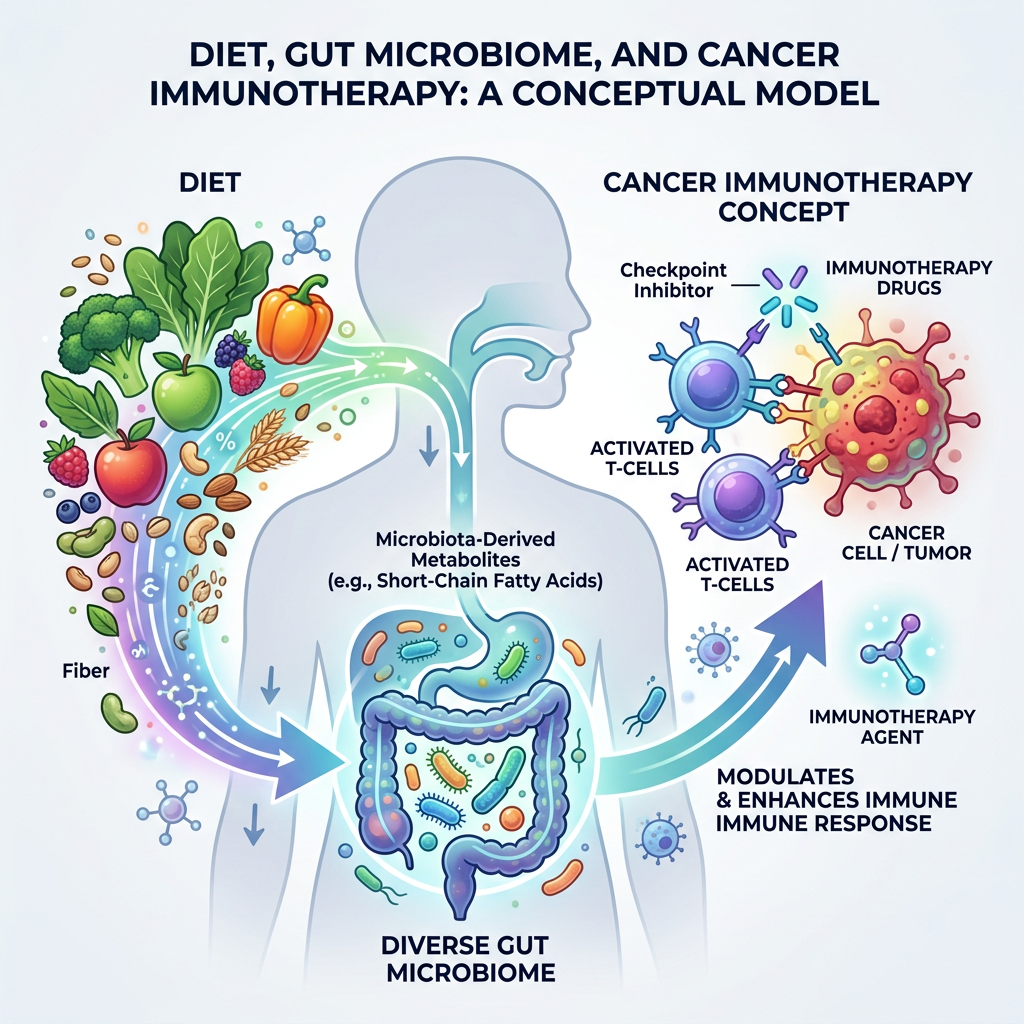
The emerging conversation around how diet affects cancer immunotherapy outcomes is forcing a shift in how we think about medicine itself.
The Invisible Negotiation Behind Everyday Eating
You don’t think about your breakfast as something that could influence whether a life-saving drug works.
You think of it as routine. Habit. Taste.
But what if the quiet, repetitive act of eating is not just sustaining your body—but quietly negotiating with your treatment?
When Advanced Medicine Meets Biological Uncertainty
The growing conversation around how diet affects cancer immunotherapy outcomes is not just about nutrition anymore—it’s about control.
Immunotherapy, particularly immune checkpoint treatments, has been positioned as one of the most advanced weapons against cancer. Yet, its success rate remains uneven. Some patients respond dramatically. Others don’t respond at all.
This inconsistency has forced medicine to ask a difficult question:
What if the difference isn’t just in the drug—but in the body receiving it?
And more specifically: in the invisible ecosystem living inside it.
The Body as a Variable, Not a Constant
Modern medicine has long operated under an implicit assumption: that treatments act on a relatively stable biological baseline.
But that assumption is beginning to fracture.
The human body is not a fixed system—it is a dynamic, adaptive environment shaped daily by what we eat, how we live, and the microbes we host. This means that two patients receiving the same therapy are not actually receiving the same treatment experience.
They are receiving it in entirely different internal landscapes.
This is where the idea of how diet affects cancer immunotherapy outcomes becomes more than a nutritional question—it becomes a systems question.
The Gut Microbiome as an Immune Control Layer
The gut microbiome has emerged as one of the most influential regulators of immune behavior. It doesn’t just digest food—it trains immune cells, modulates inflammation, and influences how aggressively the body responds to threats.
In simple terms:
Your immune system does not act alone. It acts in conversation with your gut.
This creates a powerful implication.
If immunotherapy works by activating the immune system to attack cancer cells, then anything that shapes immune behavior—like diet—can indirectly shape treatment outcomes.
Food, in this context, stops being passive input. It becomes a signaling mechanism.
From Nutritional Support to Biological Programming
What’s shifting now is not just scientific understanding—but conceptual framing.
We are moving from:
- “Food supports health”
to
- “Food programs biological response”
This is a profound shift.
Because if diet can influence immune cell activity, persistence, and targeting behavior, then eating patterns become part of the therapeutic equation.
Not as an alternative—but as a multiplier.
Mechanisms Beneath the Surface: How Small Inputs Compound
Emerging research patterns suggest three key mechanisms through which diet may influence immunotherapy outcomes:
Microbial Composition as a Foundational Layer
Different diets cultivate different microbial communities. Fiber-rich, fermented, and diverse diets tend to support bacteria linked with stronger immune responses.
Immune Cell Activation Pathways
Certain microbial metabolites can influence T-cell behavior—the very cells responsible for identifying and attacking cancer.

Inflammation as a Modulatory Force
Diet can either amplify or suppress chronic inflammation, which plays a complex role in cancer progression and treatment response.
These are not isolated pathways. They are interconnected.
Which means small, consistent dietary inputs may compound into measurable biological differences over time.
From Isolated Treatment to System-Level Design
So what does this actually mean?
It means we are entering a phase where treatment is no longer just about what is prescribed, but what surrounds the prescription.
The effectiveness of advanced therapies may increasingly depend on:
- gut health
- metabolic state
- immune readiness
- lifestyle patterns
In other words:
Medicine is moving from intervention to environment design.
This reframes the patient from a recipient of treatment to an active participant in outcomes.
Not in a motivational sense—but in a biological one.
Rethinking Daily Choices as Clinical Variables
This is where the insight becomes personal.
If how diet affects cancer immunotherapy outcomes continues to gain evidence, then a few subtle but powerful shifts follow:
- Food choices are no longer just about long-term prevention—they may influence immediate treatment response
- Consistency in diet becomes more important than occasional “healthy” decisions
- Gut health becomes a measurable, actionable parameter—not an abstract concept
But there’s also a caution embedded here.
This does not mean:
- food replaces treatment
- dietary changes guarantee outcomes
- all interventions are equally effective
The real takeaway is more nuanced:
The margin between response and non-response may be smaller—and more influenceable—than we assumed.
The Quiet Question That Changes Everything
We started with a simple idea: that breakfast is routine.
But that assumption is becoming harder to sustain.
Because if the internal environment of the body determines how treatment behaves, then daily habits are no longer background noise—they are part of the signal.
And that creates a quiet but unsettling question:
If outcomes are shaped not just by medicine, but by the conditions we create inside ourselves…
how much of treatment has always been happening outside the prescription?
Embedded Insights Worth Remembering
- “Medicine doesn’t act in isolation—it acts in an environment.”
- “The difference between response and resistance may not be the drug, but the biology it enters.”

Leave a Reply