Which is the best thing to do in your city?
Every year, millions of people walk through Delhi and see the Mughals. They see Red Fort, Humayun’s Tomb, Jama Masjid — structures of genuine grandeur and undeniable historical significance. What almost none of them see — because almost no travel writing, no heritage tour, and no mainstream English-language guide ever tells them — is what was here before. Not centuries before. Millennia before.
Delhi’s ancient Hindu history is not a footnote to the Mughal chapter. It is the ground on which every subsequent chapter was written, and it stretches back into the era of the Mahabharata, the Mauryan Empire, and the Gupta dynasty — three of the most consequential civilizational moments in human history. The Mughals arrived in Delhi in 1526. The civilization they found had already been accumulating for 2,700 years. This is the story that has not been told. Not adequately. Not honestly. And, not in full.
The Pandavas Were Here. The Archaeology Confirms It.
Begin where all serious inquiry into Delhi’s past must begin: the mound at Purana Qila — the Old Fort — which stands on the western bank of the Yamuna River in the heart of the city. The fort visible today was built in the 16th century by Humayun and later expanded by Sher Shah Suri. But beneath its walls, inside that ancient earthen mound rising eleven meters above the surrounding landscape, lies something entirely different.
The Archaeological Survey of India has been excavating this site for decades across seven rounds of excavation. What they found changed Delhi’s traceable history permanently. Painted Grey Ware pottery — a unique grey-colored, well-fired ceramic with black spot designs — was recovered from the deepest cultural layers of the mound, carbon-dated to 1200–800 BCE. This is not a marginal or ambiguous find. The identical pottery type has been recovered from Hastinapur, Kurukshetra, and Tilpat — sites named directly in the Mahabharata. Archaeologist B.B. Lal, who led the pioneering excavations at Mahabharata sites in the 1970s, established Painted Grey Ware as the material signature of that civilization. Its presence at Purana Qila places this soil within that same civilizational horizon.
Pandavon Ka Qila: The Fort of Pandavas
The site has been known locally as Pandavon ka Qila — the Fort of the Pandavas — for as long as oral memory records. Even Abul Fazl, the court historian of Mughal Emperor Akbar, recorded in the Ain-i-Akbari that Humayun chose this site because it was the location of Indraprastha — the legendary capital of the Pandavas. A Mughal court document acknowledged that the empire was building on a Hindu civilizational foundation. That acknowledgment was then quietly written out of most subsequent accounts of Delhi’s history.
Until 1913, a village named Inderpat existed inside the fort’s walls — a living settlement whose very name preserved the memory of Indraprastha across millennia. The British displaced it during the construction of New Delhi. The archaeological museum inside Purana Qila today displays artifacts recovered from these excavations: sickles, terracotta figurines, kiln-burnt bricks, seals, and pottery that predate the Mughal structure above them by over two thousand years. Most visitors walk past this museum to photograph the Mughal-era gates.
ASI Director Vasant Swarnkar, who led recent excavations, has been careful to note that while the PGW findings are significant and genuine, declaring the site definitively as Indraprastha requires further excavation. The evidence is strong enough to demand serious historical attention. It confirms a flourishing civilization on this exact soil during the Mahabharata period. That alone is extraordinary — and almost entirely absent from how Delhi presents itself to the world.
The Iron Pillar: A Gupta Devotional Monument Standing Inside a Mosque
Walk into the Qutb Complex in Mehrauli and most visitors look upward — toward the towering Qutb Minar behind. What stands directly in the courtyard in front of them receives a glance, occasionally a photograph, and almost never the attention it deserves.
The Iron Pillar is 7.21 meters tall, weighs more than six tonnes, and has not rusted in 1,600 years. It was forged during the reign of Chandragupta II — the Gupta Emperor who ruled from approximately 375 to 415 CE — and bears a Sanskrit inscription in Brahmi script eulogizing his military victories. This was originally erected as a Vishnudhvaja — a devotional standard of Lord Vishnu — at the Varah Temple in Udayagiri Caves in Madhya Pradesh. It once bore a Garuda statue — the eagle mount of Vishnu — at its apex. That figure is gone. The pillar remains.
It was relocated to Delhi by the Tomar Rajput king Anangapal in the 11th century CE, who established Lal Kot — Delhi’s first fortified settlement — in what is now Mehrauli. When the Mamluk Sultanate arrived and built the Quwwat-ul-Islam mosque — the first mosque on the Indian subcontinent — using stones from 27 demolished Hindu and Jain temples, the pillar was too massive to move. It was left standing in the mosque courtyard, where it remains today: a 4th-century CE Hindu devotional monument, forged during the golden age of the Gupta Empire, surrounded by the architecture of the dynasty that demolished the temple complex it once anchored.
Scientific Story of the Pillar
The scientific story of the pillar is as remarkable as its history. Modern metallurgy struggled for centuries to explain why it had not corroded. In 2003, researchers at the Indian Institute of Technology Kanpur published their findings in the journal Current Science. The pillar is composed of high-purity wrought iron with approximately 1% phosphorus content — far higher than modern iron — and lacks sulfur and magnesium. Ancient craftsmen used a forge-welding technique, hammering heated iron in a way that preserved the phosphorus concentration and allowed a crystalline iron hydrogen phosphate hydrate layer to form on the surface over centuries, acting as a permanent corrosion shield. The technique was not replicated in industrial metallurgy. It was understood only in retrospect, 1,600 years later, by a modern research institution.
Professor R. Balasubramaniam of IIT Kanpur, who led this research and authored the definitive book on the subject, described the pillar as a living testimony to the skill of metallurgists of ancient India. It is not a mystery. It is a documented achievement — one that modern science had to work to catch up with.
Yogmaya Temple: Where Krishna and Arjuna Prayed During the Mahabharata War
Fifteen minutes on foot from the Qutb Minar, hidden inside the walls of Lal Kot among residential lanes that most visitors never enter, stands a temple that represents one of the most continuous threads of living religious practice in any world capital.
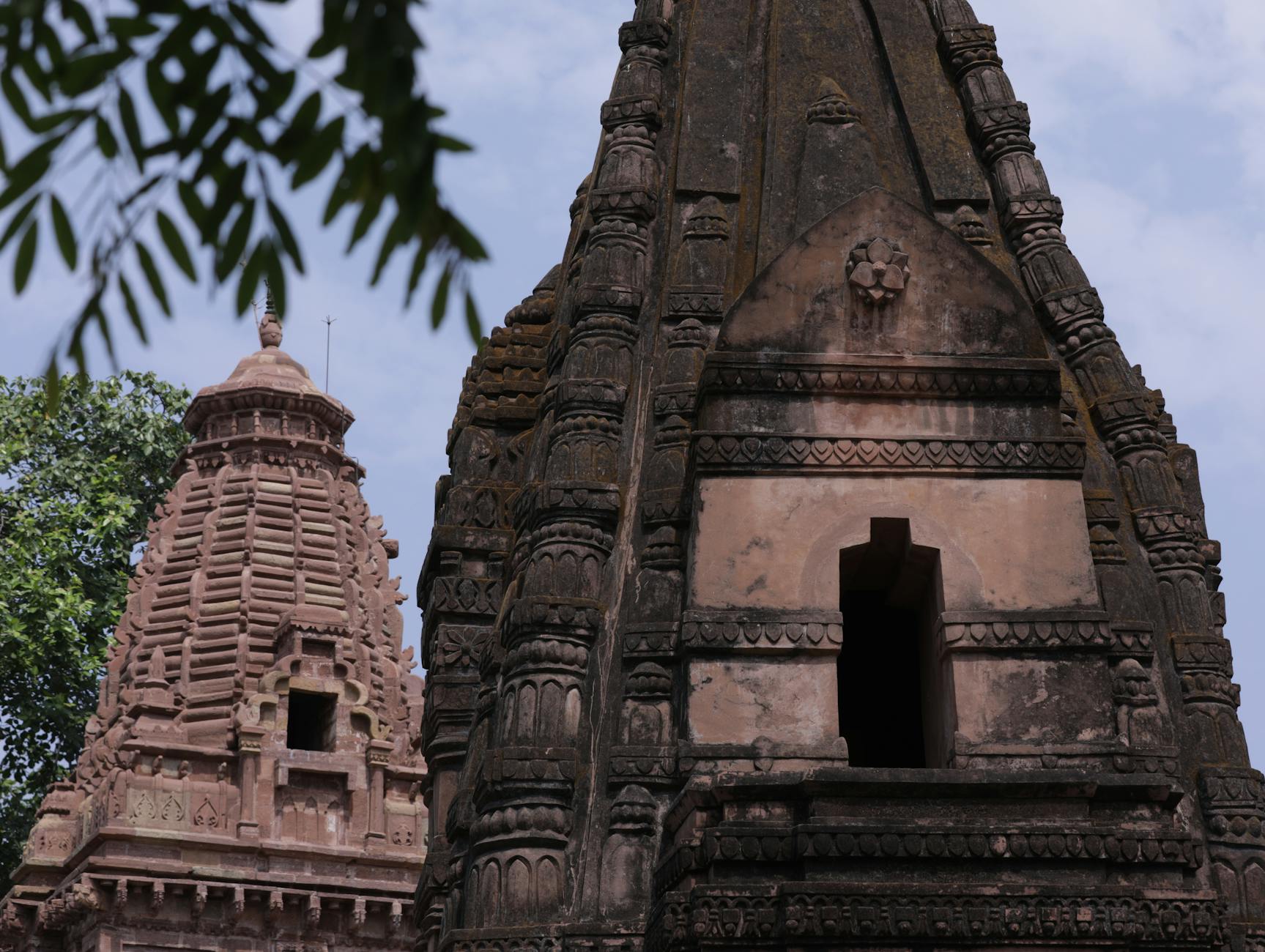
Yogmaya Temple in Mehrauli is, according to both tradition and the 12th-century Jain text that names the surrounding area Yoginipura after this very temple, one of the five surviving temples from the Mahabharata period in Delhi. It is dedicated to Yogmaya — the sister of Lord Krishna, born to his foster parents Yashoda and Nand as the divine decoy who foiled Kansa’s attempt to kill the infant Krishna at birth. She is considered one of the 51 Shakti Peethas — the sacred geographic network across the subcontinent where the energy of Goddess Sati is considered immanent.
Krishna, Arjuna, and Yogmaya
The temple’s connection to the Mahabharata is specific. According to tradition preserved by the temple’s hereditary priests, Krishna and Arjuna came here to pray during the war. After Arjuna’s son Abhimanyu was killed by Jayadratha, Arjuna took a vow to kill Jayadratha by the following evening or self-immolate. The Kauravas kept Jayadratha protected, making the vow seemingly impossible to fulfill. Krishna and Arjuna came to Yogmaya — the goddess of divine illusion — and prayed for intervention. The goddess created a temporary eclipse, allowing Arjuna to complete his vow. The sun returned. Jayadratha was killed.
This temple was among the 27 temples demolished by the Mamluks during the early Sultanate period. It is the only one from that group still in active use. It has been attacked by Mahmud of Ghazni, partially destroyed by Timur, modified during Aurangzeb’s reign, and rebuilt repeatedly. has survived not through government protection or institutional heritage management but through the continuous devotion of approximately 200 people — a community who share a common ancestral tradition of custodianship, maintaining the temple’s daily rituals, prasad preparation, and twice-daily adornment of the deity across generations.
The 12th-century Jain reference is important for an additional reason: Mehrauli was named Yoginipura — after this temple — before it was called Mehrauli. The temple was the naming anchor of the entire district. That fact has been almost completely erased from the public understanding of one of Delhi’s oldest neighborhoods.
Kalkaji Mandir: A Shakti Peeth Older Than Delhi’s Name
Kalkaji Mandir sits in South Delhi near Nehru Place, directly accessible by metro, visited by thousands of devotees daily. Most people understand it as one of Delhi’s major active temples. Very few understand that they are standing at one of the oldest continuously worshipped sacred sites in northern India — and that its sacred landscape includes one of the most ancient royal inscriptions on the Asian continent.
The temple is dedicated to Goddess Kali — Maa Adi Shakti in one of her most powerful manifestations. It is classified as a Shakti Peeth, where the right foot of Goddess Sati is believed to have fallen, and as Manokamna Siddha Peetha — the shrine where sincere prayers find fulfillment. Its legendary origins are placed in the Satya Yuga, the first age of creation in Hindu cosmology, when the goddess manifested to destroy the demon Raktabija whose blood produced new demons wherever it fell. The Pandavas are recorded in temple tradition as having worshipped here before the Kurukshetra war. Lord Krishna and Arjuna are said to have sought blessings from the goddess at this site.
The temple’s current structure dates to 1764 CE, when the Marathas — who arrived in Delhi with a specific intention to restore ancient Hindu sacred sites suppressed under Mughal rule — rebuilt it. The Maratha restoration of Kalkaji was not an act of new construction. It was a reclamation. The Marathas recognized, correctly, that this site had been a center of continuous worship since antiquity and that its physical structure had been degraded through centuries of deliberate neglect and suppression. They rebuilt it as both a spiritual and a civilizational act.
One kilometer north of Kalkaji Mandir, inside a small public garden in Srinivaspuri that almost no tourist map marks, is a protected rocky outcrop that holds something extraordinary.
Emperor Ashoka’s Personal Message, Still Legible on a Rock in South Delhi
In approximately 257 BCE, Emperor Ashoka — the Mauryan ruler who governed one of the largest empires the ancient world had seen — sent instructions across his territory to have his personal message inscribed on rocks and pillars at key locations along trade routes. One of those inscriptions was carved on a rocky hillside in what is now South Delhi. It has been there for 2,300 years.
The Bahapur Minor Rock Edict was discovered on March 23, 1966, by ASI archaeologists M.C. Joshi and B.M. Pande — not through planned heritage survey but because a building contractor named Shri Jung Bahadur reported an inscribed rock that was scheduled to be blasted to make way for a new residential colony. The contractor noticed it and stopped. The archaeologists came, examined it, and identified it as a Minor Rock Edict of Ashoka — one of only 13 such inscriptions found across the entire Indian subcontinent.
Ashoka, Kalinga War, and Buddhism
The inscription measures approximately 75 by 76 centimeters, written in Brahmi script in the Prakrit language of the Mauryan court. It is a first-person message from Ashoka to his subjects. Translated, it reads: “It is two and a half years since I became a Buddhist layman. At first no great exertion was made by me, but in the last year I have drawn closer to the Buddhist order and exerted myself zealously. This goal is not restricted to the great — even a humble man who exerts himself can reach heaven. This proclamation is made to encourage both the humble and the great to exert themselves, and to let those beyond the borders of the kingdom know about it.”
Ashoka wrote this after the Kalinga War, in which his own edicts record that 150,000 people were forcibly displaced, 100,000 were killed in battle, and many more died afterward. The horror of that scale of violence broke him. He converted to Buddhism, renounced conquest, and spent the remainder of his reign attempting to propagate dharma — ethical, compassionate living — across his empire. This rock, in this park, in South Delhi, is one of the physical traces of that transformation.
Ancient Uttarapath Trade Route
The site is located directly on the ancient Uttarapath trade route — which explains why Ashoka chose this specific hillside for inscription. Travelers and merchants moving along that route would pass this message. The location was deliberate, functional, and carefully chosen. It is now a small garden that most residents of the surrounding neighborhood use for morning walks, unaware of what is protected behind a metal grille at the far end of the path.
Additionally, Delhi holds two Ashokan pillar edicts — the Delhi-Meerut pillar on the Delhi Ridge near Bara Hindu Rao Hospital, and the Delhi-Topra pillar at Feroz Shah Kotla. Both were transported from their original locations in Meerut and Ambala by the medieval Sultan Feroz Shah Tughlaq in the 14th century, who admired the inscribed sandstone columns and relocated them to Delhi as objects of historical reverence. Even a medieval Sultan recognized their significance. The city that surrounds them largely does not.
Gurudwara Sis Ganj Sahib: The Most Consequential Site in Chandni Chowk
In the middle of Chandni Chowk — Delhi’s oldest, loudest, most commercially saturated market street — stands a gurudwara that most people pass without stopping. It marks the site of one of the most morally significant acts of resistance to religious tyranny in South Asian history.
On November 11, 1675, Guru Tegh Bahadur — the ninth Sikh Guru — was publicly beheaded in this square on the orders of the Mughal Emperor Aurangzeb. His crime, in the language of the imperial charge, was being an obstacle to the spread of Islam in the Indian subcontinent. His actual offense was more specific: he had refused to convert, and he had refused to stop protecting Kashmiri Hindu Brahmins who had come to him facing forced conversion under Aurangzeb’s religious policy.
Pre-modern Indian History
The sequence of events that led to this moment is one of the most remarkable instances of interfaith solidarity in pre-modern Indian history. In early 1675, a delegation of Kashmiri Pandits led by Pandit Kripa Ram came to Guru Tegh Bahadur at Anandpur Sahib. Aurangzeb had issued an ultimatum: convert to Islam or face execution. The Pandits had no army, no political recourse, and no time. They asked the Guru for help. He was a Sikh. Their crisis was Hindu. He chose to stand with them regardless.
Guru Tegh Bahadur traveled to Delhi, presented himself to the Mughal court, refused to convert, and was executed. His companions — Bhai Mati Das, Bhai Sati Das, and Bhai Dyal Das — were tortured and killed alongside him. A loyal disciple, Bhai Jaita, recovered the Guru’s severed head and carried it to Anandpur Sahib for cremation, defying the Mughal imperial guard. Another disciple, Lakhi Shah Vanjara, burned his own house to cremate the Guru’s body. Gurdwara Rakab Ganj Sahib, near Parliament House, marks the site of that cremation.
Hind Di Chadar: The Shield of India
The Sikh community titles Guru Tegh Bahadur “Hind Di Chadar” — the Shield of India. The Indian Army’s Sikh regiment formally salutes Gurudwara Sis Ganj Sahib before saluting the President of India. That is the institutional acknowledgment of what this site represents in the national moral hierarchy.
The gurudwara was first built as a small shrine in 1783 by the Sikh military commander Baghel Singh. The current structure was completed in 1930 following a Privy Council. It was ruling in favor of Sikh litigants after prolonged legal dispute. Every day, without exception, it serves langar — free community meals — to anyone who enters. Regardless of faith, caste, income, or nationality. It is in the middle of Delhi’s most commercially driven street. The response to an act of state religious violence is commemorated daily through an act of unconditional welcome. The contrast is not accidental. It is the whole point.

Lal Kot and the Rajput Foundation
Before any of Delhi’s “seven cities” were proclaimed. Before any Sultanate, before any Mughal presence. There was Lal Kot. It is the earliest known fortified settlement on Delhi’s soil. It was built by the Tomar Rajputs in approximately the 8th century CE. And, in fact, it preceded the Delhi Sultanate by four hundred years.
The Tomars were followed by the Chahamanas. It was the dynasty of Prithviraj Chauhan. The dynasty that expanded Lal Kot into Qila Rai Pithora. It ruled from this region until his defeat at the Second Battle of Tarain in 1192 CE. That battle, fought near modern Taraori in Haryana. It transformed Delhi from a Rajput capital into the seat of the Delhi Sultanate. The consequences are architecturally visible across the Mehrauli landscape. The Yogmaya Temple — kuldevi of the Chauhan clan — survived. T0he Iron Pillar, relocated by the Tomars, survived; the walls of Lal Kot survive in partial form, absorbed into later construction, still traceable.
The Rajput civilizational presence in Delhi was not erased. It was, in fact, stratified — buried under newer layers. But, actually, structurally intact beneath them. The sacred geography of Mehrauli. Its temple locations. Its water management systems, its defensive topography. Everything, in fact, reflects the planning intelligence of a civilization that governed this landscape for centuries before the Sultanate arrived.
What Delhi Has Always Been
Delhi’s deepest identity is, in fact, not Mughal. It is, actually, not even medieval. It is the product of continuous civilizational layering. The Vedic kingdoms, Buddhist imperial edicts, Rajput forts. Then, Gupta metallurgical achievement, Mahabharata-era temples, Sikh martyrdom. Each stratum built over the previous one, each still partially legible to those willing to look.
The Painted Grey Ware at Purana Qila connects this soil to 1200 BCE. The Ashoka Rock Edict at Srinivaspuri connects it to 257 BCE. The Iron Pillar connects it to the Gupta golden age of the 4th century CE. The Tomar Rajputs built Lal Kot in the 8th century. The Chauhans held it until 1192. The temples of Yogmaya and Kalkaji maintained living traditions through invasions, demolitions, and centuries of deliberate suppression.
None of these sites require special access. None demand prior expertise. The Yogmaya Temple is a fifteen-minute walk from the Qutb Minar. The Ashoka Rock Edict is inside a public park. Purana Qila’s archaeological museum is open. Gurudwara Sis Ganj Sahib is in Chandni Chowk. The Iron Pillar stands in one of the country’s most visited heritage complexes.
What they require is the decision to look at this city in its full depth. Which, in fact, is not just at the 500 years that English-language travel writing made famous. But, instead, at the 2,500 years that preceded them and built the foundation upon which everything else was placed.
Delhi is 3,000 years old. It has been a site of Hindu worship, Buddhist philosophy, Rajput governance, Gupta science, Sikh sacrifice, and civilizational memory. Everything that predates most nations on earth. That is the city that exists beneath the one most people visit. It has always been there. It has simply been waiting for the honest account it deserves.


Leave a Reply