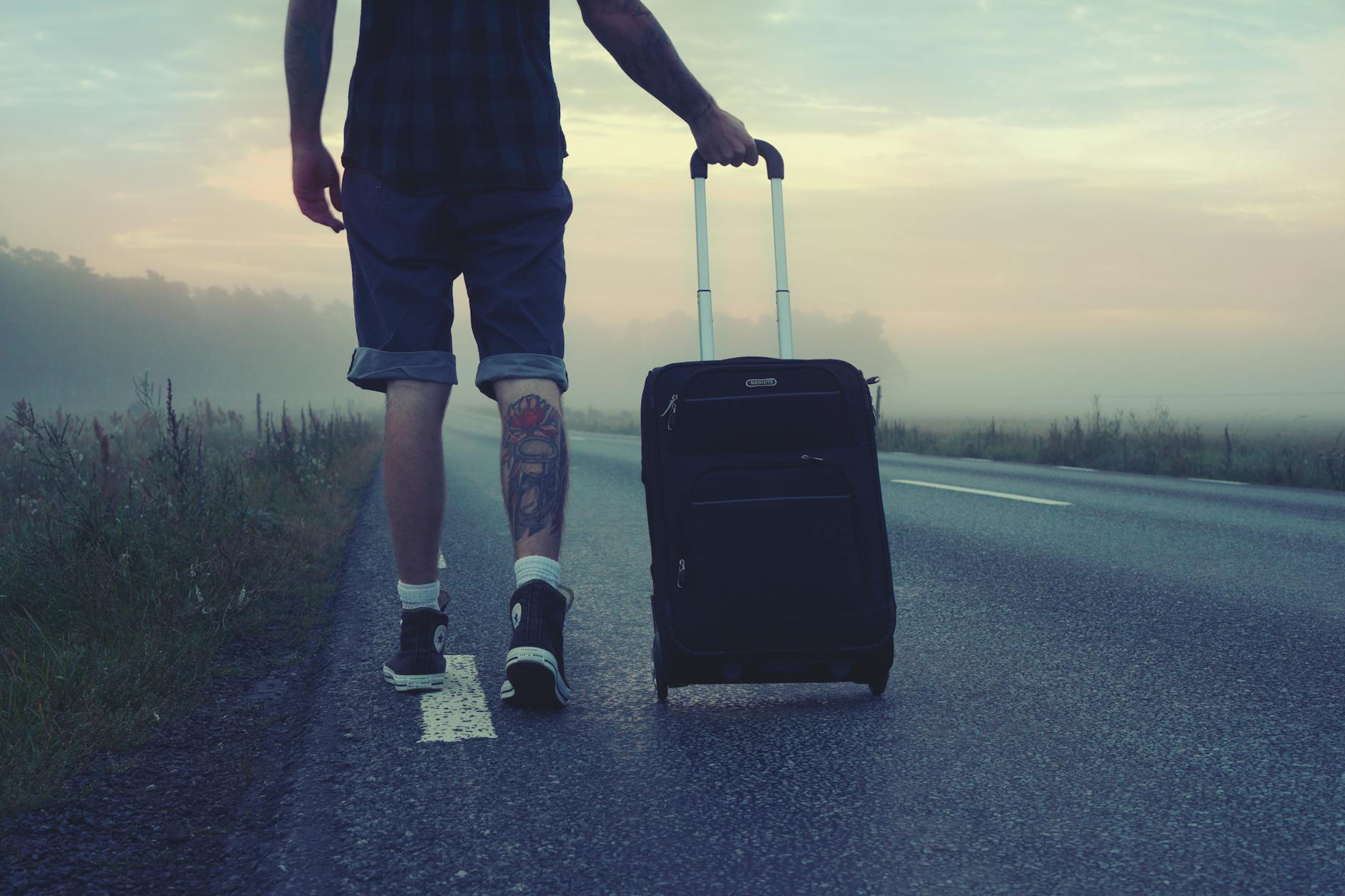
How do you plan the perfect road trip?
The best moment of any road trip is always unplanned.
Before the Engine Starts
I spread the map on the kitchen table the way I imagine a surgeon spreads open the chest — with ceremony, with the quiet arrogance of someone who believes the interior can be known before it is entered.
I trace the routes with a finger. And, I highlight in yellow the roads I will take, and in orange the towns where I will stop, as if color could contain the future, as if the road would read my notes and agree to cooperate.
This is how every journey begins — not with movement, but with the illusion of it. The dream of arrival before the difficult work of departure.
There is a particular silence that lives in a car before the engine starts.
You have loaded everything — the bag with three more shirts than you need, the playlist assembled over weeks as if the right sequence of songs could protect you from what the miles uncover, the snacks for a hunger that isn’t yet hunger, the charged devices through which you plan to document a beauty you have not yet seen.
You sit. The house is visible in the rearview mirror.
And there it is — that soft grief of leaving, nameless and loyal, the way a dog follows you to the door even though it knows it cannot come.
You are not sad. You are something more specific than sad. In fact, you are a person in the precise moment of choosing the unfamiliar over the comfortable, and feeling both the rightness and the cost of that choice at the same time.
The key turns. The engine starts.
For the First Hour
For the first hour, you are still the person you were at home.
You follow the highlighted roads. You check the time against the plan. And, you eat at the hour you scheduled eating. You are efficient. You are on track. Moreover, you are traveling the way a stone travels when thrown — aimed, obedient, subject entirely to the force that launched you.
But somewhere after the city dissolves and the road opens its long argument with the horizon, something begins to loosen.
I cannot tell you exactly where it happens. There is no mile marker for it. It is more like the moment in a river where the current deepens without warning — you feel it in your body before you see it, a gentle acceleration, a giving over.
I took the wrong exit once — or what I thought was the wrong exit.
The road narrowed into something that had not expected to be a road for very long. Trees on both sides leaning in the way elders lean in when they want you to stop talking and start listening.
I almost turned back.
I drove instead into a valley I cannot find now on any map I own, and there was a lake there — still in the way that only deep water can be still, holding the sky’s reflection so faithfully that for a moment I could not tell which was above me and which was below.
A heron stood at the water’s edge. It did not move. It was so completely itself that I felt, by comparison, somewhat approximate.
I sat beside that lake for an hour I had not planned.
Every Road Teaches
This is what the road teaches if you let it:
that the map is a story you tell yourself before you know what the story is actually about.
That the highlighted route is just the question. The road is the answer, and it takes longer than you budgeted, and it leads somewhere other than you expected, and what it gives you is never what you thought you needed but is always, in the end, what you actually needed.
I have driven through weather that was not on the forecast.
I have watched a sky darken from the west the way a bruise comes up — slowly at first, then all at once — and I have pulled over not because I was frightened but because the storm was so enormous and I was so small and that ratio felt, in that moment, like the most honest thing I had experienced in months.
There is something clarifying about the road in its relationship with scale.
At home, you are the right size for everything around you. Your ceilings were built for you. Your streets are proportioned for your particular kind of motion. You fit.
On the road, a mountain range does not care about your dimensions. A sky full of weather does not make accommodations. A long straight highway across a salt flat reduces your vehicle to a moving dot in a geometry so vast it almost becomes an argument against the importance of hurry.
And you feel, strangely, not diminished by this — but clarified.
Stop Being Overhead
There is a particular quality of light that happens late in the afternoon in open country — when the sun has dropped low enough to become personal, to stop being overhead and become oblique, to throw shadows that are longer than the things that cast them.
I have chased that light without meaning to.
I have driven further than I planned simply because the light was doing something with a field of dry grass that I could not bring myself to drive past, and then it was doing it with a stand of cottonwoods, and then with the underside of a bridge, and by the time the light was finished with me I was somewhere I had not intended to be and I was exactly where I needed to be.
The stars on a clear night, far enough from any city to have earned them, are not what you expect if you have only known them as decoration.
They are abundant in a way that disturbs comfort. There are so many of them that the night sky ceases to be a background and becomes a foreground — and you, lying in a sleeping bag on the warm hood of your car, are suddenly the background, the minor thing, the small presence in a very large presence.
I have heard people say that looking at the stars makes them feel small.
What they mean, I think, is that it makes them feel accurate.
The smallness was always there. The stars just confirm it without unkindness.
Stop Checking the Plans
Somewhere — I cannot say exactly when — I stopped checking the plan.
Not because I forgot it. But because the journey had become more interesting than the plan’s idea of itself.
I had stopped asking where I was going and started asking what was here.
And what was here was almost always something I would not have looked for if I had been looking.
A town with a name that made me laugh. A roadside stand selling fruit I had never tasted from a woman who told me the name of the tree in a language I did not speak, and I stood there in the sun eating something unnamed in my vocabulary and it was perfect, not because it was exotic, but because it was real and I was real and for a moment we were simply two living things in the same afternoon.
I think this is what the road trip is really asking, beneath all the planning and provisioning, beneath the apps that calculate the fastest route and the satellite voices that tell you when to turn:
Are you willing to be surprised? Are you willing to be wrong about what you need? And, are you willing to arrive somewhere you did not intend to go and recognize it, anyway, as the destination?
The road does not promise beauty. It promises encounter. And encounter is not always comfortable, and comfort is not always beautiful, and beauty is not always what we thought we were chasing when we got in the car.
The Roads I Have Taken
What I have learned from the roads I have taken — the planned ones and the accidental ones, the efficient ones and the lost ones — is that the perfect road trip does not exist before you take it.
It is not in the preparation, though preparation matters. It is not in the arrival, though arrival is real.
In fact, it is in the quality of attention you bring to the moving.
It is in whether you are willing to pull over for no reason except that something is beautiful. In whether you can sit with the discomfort of not knowing what is around the next bend. In whether you allow the silence between songs to be a thing that exists, rather than rushing to fill it.
The map is still on the table when I come home.
Yellowed a little now by the hours I was gone. The highlighted routes still visible, some of them traveled, some of them abandoned for something better.
I look at it the way you look at a draft — with fondness for the intention, with gratitude for the departure from it.
Because the road I actually traveled is not on this paper. It lives somewhere between the miles and the memory, in the body that drove through morning after morning, in the particular way I now hold my own smallness after standing under those stars.
A Perfect Road Trip
How do you plan the perfect road trip?
You plan enough to leave. You plan enough to have a direction, a reason to start, a first road to turn onto.
And then —
you loosen your grip on the rest.
You allow the detour. Then, you allow the weather. You allow the unscheduled hour beside the lake and the fruit whose name you will never know and the storm that made you feel like the most honest version of yourself you have encountered in years.
You allow the road to be smarter than the plan.
Because it always is.
Because the road has been here longer than you have, and it has seen what people miss when they only follow the routes they already know.
Drive until the plan falls away.
Drive until the map is a memory and the road is a present tense.
And, drive until the horizon stops being a destination and becomes permission —
permission to keep moving, permission to keep wondering, permission to be, for a little while, a person who does not know exactly where they are going
and finds, in that not-knowing, something that feels, against all expectation,
like arrival.

Logistics, Miles, Motels, Maps
A road trip, at first glance, is logistics — miles, motels, maps. But to ask how to plan the perfect road trip is to ask something far older: how do we prepare for the unknown while desiring it? There is a profound contradiction baked into the word “plan.” Planning assumes mastery over time, over terrain, over the self that will exist at mile 400. But the road does not cooperate with plans. It breathes. It detours. And, it offers exits we never wrote down.
The tension is this: we plan because we fear. We fear being lost, being unprepared, being alone in an unfamiliar dark. Yet the very things we most remember from any journey — the roadside diner we stumbled into by accident, the storm that forced us to stop in a town whose name we never knew, the moment the radio cut out and we drove in silence for two hours and somehow felt complete — none of these were planned. They were allowed.
There is also the emotional dimension of departure. To leave is always, quietly, to grieve what you are leaving. Home. Routine. The person you were before the engine started. The road strips those away, mile by mile. And in that stripping, something essential is found — or remembered. Perhaps the “perfect road trip” is not a destination reached efficiently, but a self encountered honestly.
Philosophically, the road trip echoes the ancient concept of via negativa — knowing what something is by experiencing what it is not. On the road, away from habit, we learn who we actually are rather than who we have agreed to be. The perfect road trip, then, is not one without wrong turns. It is one in which the wrong turns become teachers.

Leave a Reply