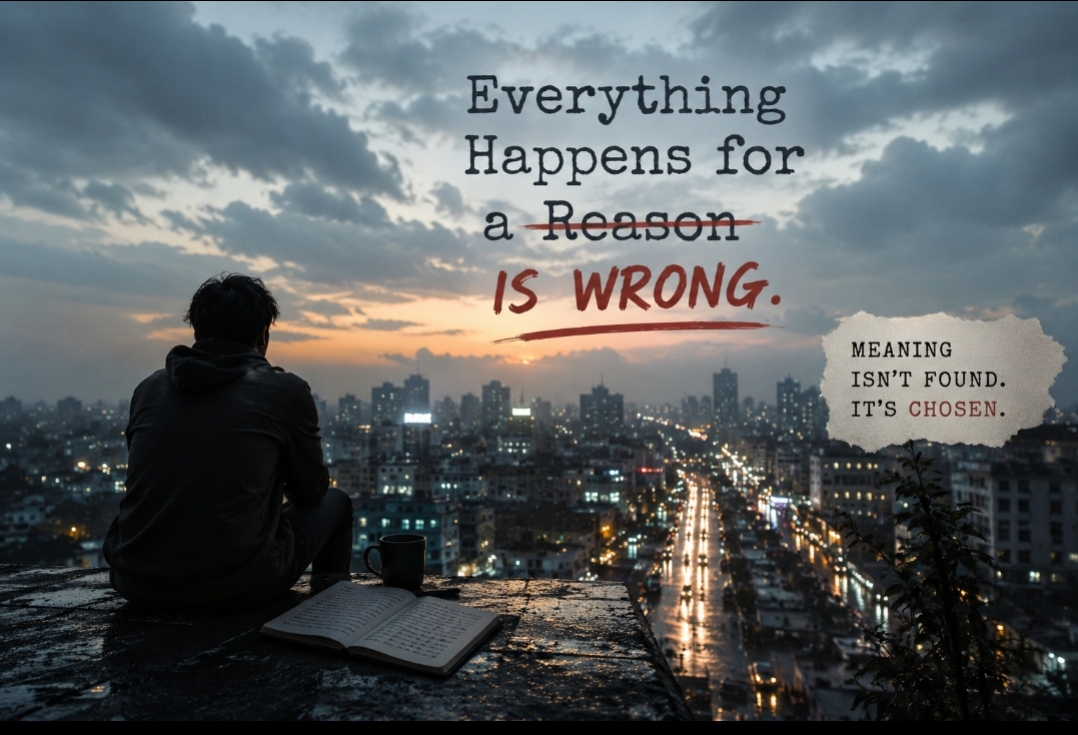
Share a proverb you think is completely wrong and make your case.
A long free-verse reflection on randomness, suffering, and chosen meaning of “Everything Happens for a Reason”
We inherit proverbs the way we inherit furniture: heavy, useful sometimes, impossible sometimes. Among them, one sentence travels everywhere—everything happens for a reason.
This everything happens for a reason poem asks what happens when the sentence fails. What remains when events arrive without messages, without design, without apology?
I. Blackout
The electricity went first.
Not dramatically.
Just a click.
The fan slowed,
the refrigerator stopped humming,
the building exhaled heat.
Outside,
rainwater collected wrappers,
dust,
small leaves,
one abandoned slipper.
Somewhere in another apartment
someone said,
as people always do,
everything happens for a reason.
The sentence moved through walls
better than electricity.
II. The Proverb We Inherit
I have carried that proverb
like a stone in my pocket.
Not because I believed it.
Because everybody handed it to me.
At funerals.
After layoffs.
After exam results.
Or,
After diagnoses.
After floods.
Then,
After phone calls beginning with:
Are you sitting down?
The sentence appears quickly,
like umbrellas sold outside stations
five minutes after rain begins.
Convenient.
Mass-produced.
Not waterproof.
III. Where the Sentence Breaks
Tell that sentence
to the child
waiting outside intensive care,
to the farmer
counting
failed rains,
to the worker
whose factory closed
because numbers on spreadsheets shifted cities,
to the stray dog
sleeping beside a tea stall
during December wind.
Tell them purpose
arranged this.
Watch language shrink.
IV. The Offense of Randomness
People dislike randomness.
I understand.
Randomness is rude.
It arrives uninvited.
It interrupts
plans.
It ignores character references.
We want suffering
to behave like mathematics.
Input grief.
Receive lesson.
Input sacrifice.
Receive reward.
Input goodness.
Receive protection.
But roads collapse
under good people too.
V. My Grandmother’s Philosophy
My grandmother used to fold plastic bags
inside other plastic bags.
Preparation disguised as thrift.
She trusted containers.
Not fate.
When illness arrived,
she did not say:
this happened for a reason.
She said:
bring water.
Call the doctor.
Sit here.
Hold my hand.
Her philosophy
fit inside actions.
VI. Waiting Rooms
In waiting rooms
meaning evaporates quickly.
Machines beep.
Numbers matter.
Oxygen matters.
Forms matter.
Names shouted through doors matter.
Purpose?
Purpose waits outside
searching for parking.
VII. Ants and Gravity
I once watched rainwater
carry ants away.
Thousands.
Entire architecture erased
by drainage design.
Were the ants selected?
Tested?
Guided?
No.
Water moved downhill.
Gravity continued employment.
VIII. Cheap Repairs for Grief
Maybe the proverb survives
because silence feels irresponsible.
Someone cries.
We answer quickly.
We patch uncertainty
with language.
But grief notices cheap repairs.
Sometimes the correct sentence is:
This is terrible.
I am here.
IX. Cities Know Better
Cities understand randomness.
A traffic signal fails.
Three roads become argument.
One missed train
changes who meets whom.
One extra minute
changes survival.
A fruit vendor chooses left instead of right.
A storm arrives earlier.
A bridge cracks.
Lives branch invisibly.
Human history may simply be
millions of tiny turns
pretending afterward
they were maps.
X. Statistics Enter the Kitchen
There was a year
when everybody learned statistics
without wanting to.
Curves.
Probability.
Risk.
Loss.
Suddenly chance
stopped being philosophy.
It entered kitchens.
We counted numbers
because numbers counted us.
And still people insisted:
everything happens for a reason.
No.
Sometimes systems fail.
Sometimes
leaders fail.
Sometimes preparation fails.
Sometimes viruses replicate.
XI. Building Meaning from Rubble
The meaning of suffering
is often manufactured afterward.
Not before.
After.
Like rebuilding a house
from surviving bricks.
You do not discover purpose
under rubble.
You bring purpose
to rubble.
XII. Nature Is Not a Judge
A mountain does not care
who climbs it.
A river does not remember
whose field it flooded.
Wind enters mansions
and unfinished buildings alike.
Nature is magnificent.
Nature is indifferent.
These truths coexist.
XIII. Adults and Their Answers
As children
we ask why.
Adults answer quickly.
Too quickly.
Because uncertainty embarrasses adults.
We iron complexity
until it resembles advice.
But reality returns wrinkled.
XIV. Inventory of Losses
A friend lost work.
Another lost hearing in one ear.
Another lost years
to bureaucracy.
Another lost someone.
No cosmic choir appeared.
No hidden envelope arrived
explaining objectives.
There were only documents.
Medicine strips.
Long calls.
Shared meals.
Human resilience.
XV. Strange Distribution
If purpose exists,
why is distribution so strange?
Why concentration here,
absence there?
Why abundance stacked beside hunger?
Why accidents choose intersections
instead of moral categories?
The mathematics of suffering
looks nothing like justice.
XVI. Narrative Machines
I have heard philosophers argue
that humans require narrative.
Maybe.
But narratives are tools.
Not weather.
We make them.
Change them.
Abandon them.
Build better ones.
XVII. Drain Water
One evening
I saw a municipal worker
clearing blocked drains
with bare hands.
Monsoon water
up to his knees.
Traffic behind him.
Nobody applauding.
If I search for meaning,
perhaps it lives there.
Not in suffering.
In response.
XVIII. Hope Without Destiny
This everything happens for a reason poem
is not against hope.
It is against outsourcing hope.
There is a difference.
Hope says:
we can build.
Fatalism says:
it was already built.
XIX. Storm Season
A tree falls during storm season.
People remove branches.
Cut wood.
Rewire cables.
Resume.
Meaning appears afterward,
wearing work clothes.
XX. Luck and Infrastructure
Sometimes people survive
because strangers intervene.
Because a driver slowed.
Because
medicine existed.
Because timing aligned.
Because someone answered.
Luck is not romantic.
Luck is infrastructure
meeting chance.
XXI. Water Marks
In old neighborhoods
walls remember floods.
Residents mark water height
with pencil lines.
Not prophecy lines.
Water lines.
Evidence.
Memory is practical.
XXII. Better Questions
The philosophy of pain
often begins incorrectly.
We ask:
Why me?
Maybe ask:
What now?
The first question
demands cosmic administration.
The second
opens doors.
XXIII. What We Owe
I do not think existence
owes explanation.
I think people owe people.
That feels more useful.
XXIV. Remaining Human
The wanderer inside me
still wants signs.
Still notices repeating numbers.
Still wonders.
I have not become stone.
I have simply become suspicious
of certainty sold cheaply.
XXV. Dawn After Rain
At dawn
after heavy rain,
cities smell rewritten.
Wet dust.
Metal.
Leaves.
Tea.
Morning vendors arranging fruit.
Children adjusting school bags.
Life rarely pauses
until philosophy catches up.
XXVI. Coexistence
Maybe this is enough:
Pain happened.
Love happened too.
Neither canceled the other.
XXVII. The Inner Child
The inner child asks:
why did this happen?
The older voice answers:
I don’t know.
Come sit here anyway.
XXVIII. Tenderness Under Uncertainty
Randomness in life
does not eliminate tenderness.
It increases its value.
Because nothing guaranteed it.
Because someone chose it.
XXIX. Why Compassion Matters
If suffering always carried purpose,
compassion would become optional.
We could simply point upward.
Instead,
because outcomes are uneven,
because
chance exists,
because systems fail,
we need one another.
XXX. The Return of Electricity
So I return
to that first blackout.
Power eventually returned.
Fans restarted.
Refrigerators hummed.
Water pumps woke.
Rain reduced itself
to dripping balconies.
And somewhere,
someone repeated:
everything happens for a reason.
I looked outside.
The city was still messy.
Still beautiful.
Still unfinished.
I think that is closer.
Not reason.
Relationship.
Not destiny.
Participation.
Not answers.
Attention.
This everything happens for a reason poem
ends where many days begin:
with uncertainty,
with tea cooling
slowly,
with ordinary people
repairing what chance damaged,
and calling that,
care.

This poem rejects forced meaning without rejecting hope. It argues that suffering often emerges from randomness, systems, biology, negligence, and luck rather than cosmic design.
When people stop searching immediately for reasons, they sometimes become more available for action: helping, repairing, organizing, grieving, rebuilding.

Leave a Reply