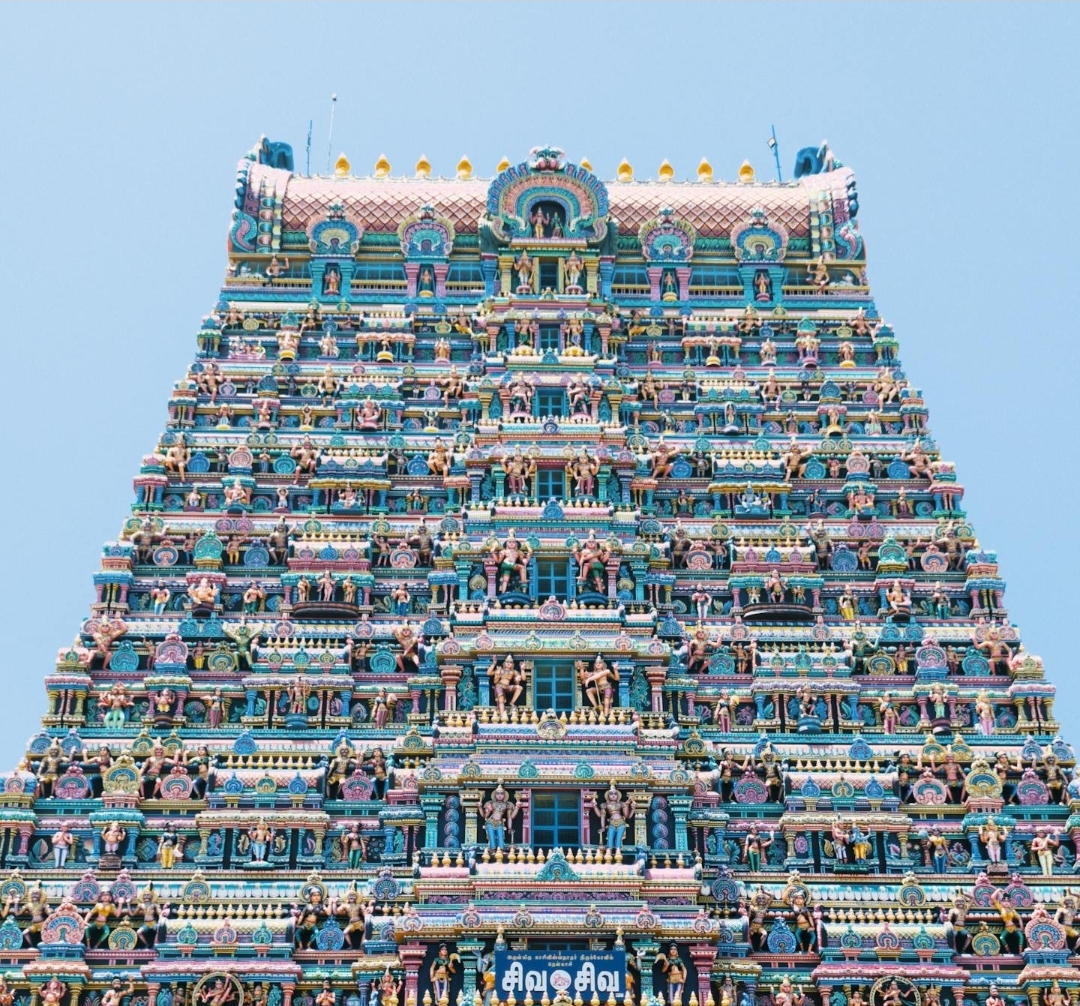
PART 1 — The Living Temple City: Srirangam as a Civilization
Where devotion is not practiced, but lived
Srirangam Temple is often described as a temple. This description, while technically correct, is fundamentally insufficient.
It is not a structure.
It is not even a complex.
It is a living city organized around the sacred.
Located on an island formed by the rivers Kaveri and Kollidam in Tamil Nadu, Srirangam is one of the largest functioning temple complexes in the world. But scale alone does not define it. What distinguishes Srirangam is that it has never been merely visited—it has been inhabited.
For centuries, people have not just come here to pray. They have lived within its enclosures, raised families, conducted trade, and organized life itself around the presence of the temple.
This dissolves a modern assumption—that spirituality is separate from daily life.
In Srirangam, there is no such separation.
The outermost enclosures contain homes, markets, and streets where life unfolds in its most ordinary forms. Vendors sell flowers, food, ritual items. Conversations happen. Children play. Time moves.
And yet, all of it exists within the gravitational field of something deeper.
There is no boundary where “life” ends and “spirituality” begins.
They are interwoven.
This integration reflects an older civilizational intelligence—one that did not compartmentalize existence. Work, worship, rest, and relationship were not isolated domains but expressions of a unified rhythm.
But this raises a subtle question for the modern reader:
What happens when life is no longer organized around meaning?
Today, cities are built around efficiency, speed, and consumption. Spaces are designed for function, not depth. The sacred, if it exists at all, is relegated to isolated moments.
Srirangam presents a different model.
Not as nostalgia, but as contrast.
It shows what it means to live in a space where the sacred is not an interruption, but a constant presence.
And yet, even here, familiarity can dull awareness.
For those who live within Srirangam, the temple can become background—just as meaning becomes background in our own lives.
Which leads to a quiet realization:
Sacredness does not depend on proximity.
It depends on attention.
PART 2 — Architecture as Consciousness: The Geometry of Inner Movement
Seven enclosures, one inward journey
The architecture of Srirangam Temple is not accidental. It is deliberate, layered, and deeply symbolic.
At its core are seven concentric enclosures, known as prakarams, each forming a rectangular boundary around the sanctum.
To the casual observer, these are structural divisions.
But experienced attentively, they reveal something else:
A designed inward movement of consciousness.
The outermost layers are expansive, dynamic, and full of life. As one progresses inward, the spatial density shifts. Corridors narrow. Activity reduces. The environment becomes more contained.
This is not merely architectural efficiency.
It is psychological guidance.
Movement through the prakarams mirrors a movement within:
From distraction → to attention
From multiplicity → to focus
From outer engagement → to inner stillness
The towering gopurams—gateway towers—mark each transition. They are not just entrances; they are thresholds of perception.
Crossing them is not only physical.
It is perceptual.
Each passage invites a subtle recalibration: to leave something behind—not materially, but mentally.
And yet, this movement cannot be forced.
One can walk through all seven enclosures and remain unchanged.
Which reveals an essential truth:
The temple offers structure.
But the journey remains internal.
At the center lies the sanctum—compact, dimly lit, and intentionally restrained. After the expansiveness of the outer layers, this contraction creates intensity.
Attention gathers.
Not because it is demanded, but because there is nowhere else to disperse.
In modern design, space is often used to impress or optimize.
In Srirangam, space is used to transform attention.
It does not tell you what to feel.
It creates conditions where something can be felt.
PART 3 — The Philosophy Within: Ramanuja and the Nature of Connection
Not oneness, not separation — but relationship
Srirangam Temple is not only an architectural and cultural phenomenon. It is also a center of profound philosophical thought—most notably associated with Ramanuja, the proponent of Vishishtadvaita (qualified non-dualism).
This philosophy occupies a subtle space between two extremes:
- Absolute non-dualism (everything is one)
- Complete dualism (self and divine are separate)
Ramanuja proposes something more nuanced:
The self is not separate from the divine.
But it is not identical either.
It exists in relationship.
This relationship is not conceptual. It is experiential—expressed through devotion (bhakti).
In this framework, the divine is not an abstract principle, but a living presence—embodied in Lord Ranganatha at Srirangam.
This shifts the nature of spiritual inquiry.
It is no longer about dissolving identity completely, nor about maintaining distance.
It becomes about participation.
To relate.
To surrender.
To engage without losing awareness.
But this introduces a paradox.
If the self is part of the divine, why is devotion needed?
Because, as Ramanuja suggests, knowing intellectually is not the same as experiencing relationally.
One can understand unity and still feel separate.
Devotion bridges that gap—not by eliminating individuality, but by softening its rigidity.
In modern terms, this has deep relevance.
We oscillate between extremes:
- Hyper-individualism (complete separation)
- Conceptual spirituality (forced unity)
Both miss the lived reality of connection.
Srirangam’s philosophical foundation offers an alternative:
To be distinct, yet not disconnected.
To be engaged, yet not lost.
PART 4 — Ritual, Time, and Continuity: The Rhythm of the Sacred
When repetition becomes a doorway
At Srirangam Temple, rituals are not occasional events. They are continuous.
Daily worship cycles unfold with precision. Offerings are made. Chants resonate. Processions occur during festivals, most notably Vaikunta Ekadasi, when thousands gather in collective devotion.
To an outsider, ritual can appear repetitive—predictable, even mechanical.
And in many cases, it becomes exactly that.
But repetition, in its essence, is not the problem.
Unconscious repetition is.
When entered with awareness, ritual becomes something else entirely:
A stabilizing rhythm for attention.
In a world where time is fragmented—divided into tasks, notifications, and interruptions—ritual introduces continuity.
It anchors experience.
The same action, performed daily, becomes a reference point—not of monotony, but of presence.
But this requires a shift in perception.
If ritual is seen as obligation, it constrains.
If seen as opportunity, it deepens.
Srirangam’s rituals have persisted for centuries—not because they enforce belief, but because they sustain a rhythm that outlives individual lives.
They connect past, present, and future in a single movement.
And yet, the risk remains.
Ritual can replace awareness.
The act continues.
But the attention disappears.
This is not unique to temples.
It is how most of life is lived.
Patterns repeated without presence.
Which makes Srirangam not just a place of ritual, but a mirror of how we engage with time itself.

PART 5 — The Inner Experience: The Illusion of Distance and the Quiet Return Within
What the temple ultimately reveals
There are places that do not announce their significance, yet alter something fundamental within us. Srirangam Temple is one such space—not because of its scale or history alone, but because of what it quietly reveals when one moves through it with attention.
By the time one enters its deeper enclosures, something has already begun to shift.
Not dramatically.
But enough.
The movement inward—through architecture, ritual, and atmosphere—creates a condition where the usual mental momentum begins to slow.
And in that slowing, something becomes visible.
“The temple does not hold the sacred — it reveals what we momentarily stop resisting.”
We often assume that sacredness resides in places. That it is contained within sanctums, accessed through rituals, granted through दर्शन.
But what Srirangam Temple reveals is more unsettling:
That what feels sacred is not something newly encountered, but something uncovered when interference reduces.
“Stillness is not found in silence, but in the absence of inner movement.”
At the sanctum, the moment of seeing Lord Ranganatha is brief.
But the state in which that seeing occurs is not.
It carries a quality—of stillness, of completeness—that does not depend on duration.
And this raises a question that extends beyond the temple:
If this state is accessible here, what prevents it elsewhere?
“Distance from the divine is not real — it is constructed.”
The mind creates distance by projecting fulfillment into locations, moments, and outcomes.
The temple becomes one such location.
We come here to experience what we believe is absent in our daily lives.
And for a moment, we do.
But the experience is not created by the place.
It is revealed through the temporary absence of distraction.
“We travel to sacred places to experience what we do not trust within ourselves.”
This is the deeper invitation of Srirangam.
Not to return repeatedly as seekers of an external state.
But to recognize what was briefly uncovered.
And to question why it feels unavailable elsewhere.
“What we seek in sanctums often waits in unnoticed moments.”
As one leaves the temple, nothing external has changed.
But something internal has been seen.
Not fully understood.
Not permanently held.
But recognized.
And that recognition alters the nature of seeking.
The temple remains where it is.
But its meaning is no longer confined to its walls.
It begins to appear—in pauses, in attention, in moments where nothing is being pursued.
Quietly.
Unannounced.
Already present.

Leave a Reply