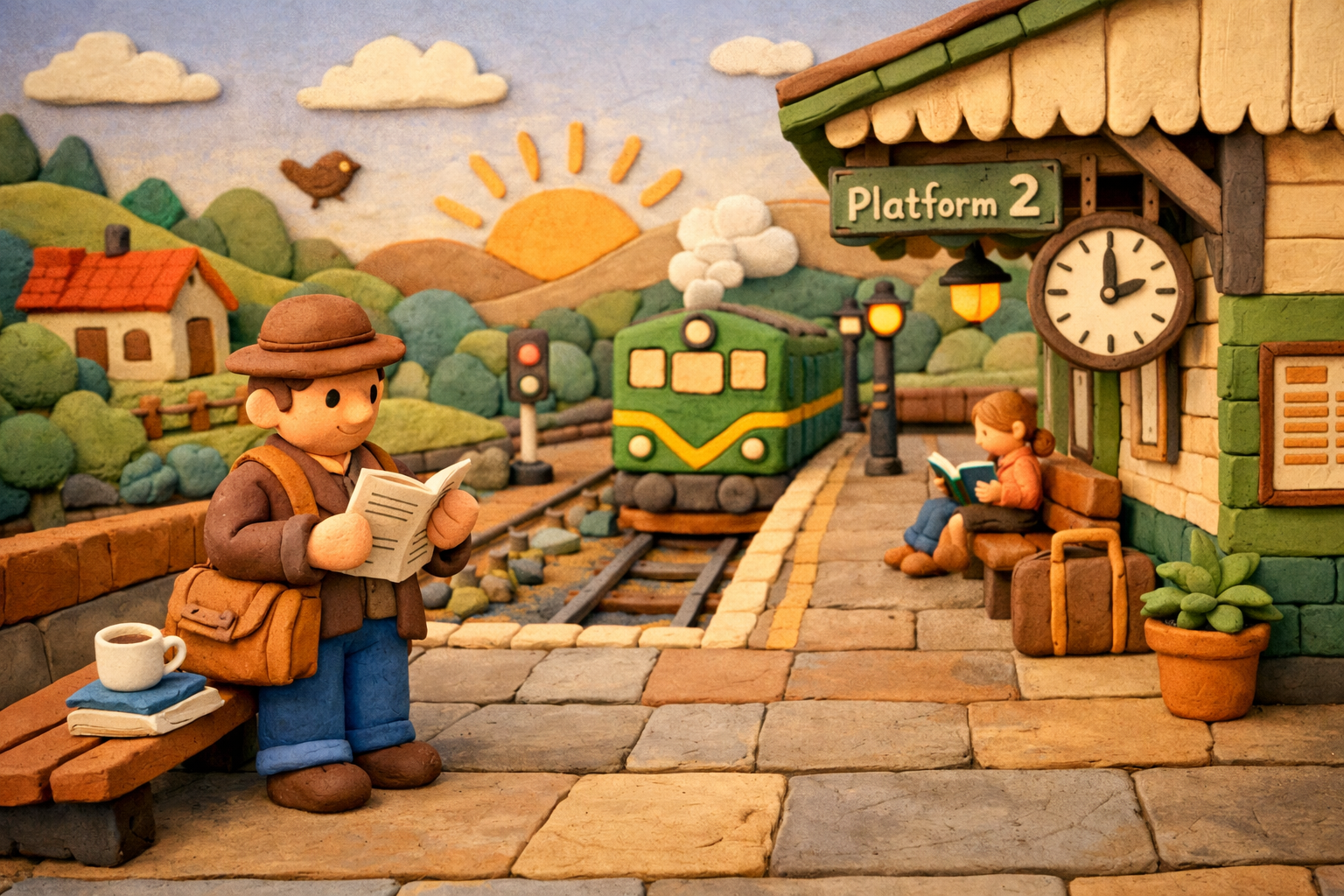
The Narrative of Staying in Your Hometown is often misunderstood as absence of movement.But movement here is subtle. It lives in routine, in recognition, in return.
The station never really sleeps.
Even when the last train has passed, it continues to breathe in fragments. A flickering tube light above the platform. A bench that remembers the shape of tired backs. The smell of tea that refuses to leave the air.
This is where everything begins and refuses to end.
And this is where the idea of the Narrative of Staying in Your Hometown first takes shape, not as a thought, but as a repetition of footsteps on old stone.
The Station That Waits Without Asking
Morning arrives slowly in the town. Not in a rush of light, but in a gradual loosening of shadows.
The tea-stall man lifts his shutter. The kettle begins to argue with itself. Steam rises like unfinished sentences.
A schoolteacher stands near the edge of the platform, adjusting a bag that never seems new, never seems old. She looks at the timetable board, though she already knows it by heart.
A courier boy sits on the same bench every day. He does not wait for a train. He waits for instructions that never fully arrive.
The station is not busy. It is consistent.
Someone once said that consistency is another form of staying.
That thought lingers, unspoken, as the Narrative of Staying in Your Hometown begins to settle into these small, repeating motions.
No one announces it. No one chooses it loudly.
It just happens, like dust choosing corners.
The Platform at Noon
The sun falls hard on the platform tiles. They turn white, almost erased.
A train arrives without urgency. Doors open. Close. People do not look at each other for long.
A woman with a folded saree sits near the waiting hall. Her hands are still, except when they adjust the edge of her bag. She is not traveling today. She is counting something inward.
The courier boy walks past her. He drops a bundle of papers at the tea stall. The tea-stall man nods without looking up.
“Same route?” the tea-stall man asks.
The courier boy shrugs. “Same roads. Different names.”
The words hang briefly, then dissolve into steam.
The Narrative of Staying in Your Hometown is not spoken here, but it is understood in the way no one boards the train for long distances anymore.
Everyone has already gone far once. Some returned. Some never left. The difference is not visible anymore.
A bell rings. Not for departure. Just habit.
Reflection Between Movements
Staying is often mistaken for absence of motion.
But here, motion exists in smaller units. In refilling cups. In repeating routes. And, in returning to the same bench without noticing the return.
No one says they are staying. They only stop leaving.
And stopping leaving is not the same as staying still.
Evening Tracks and Half Conversations
Evening bends the light into longer shapes.
The schoolteacher sits on the bench now. The courier boy is gone. The tea-stall man counts coins without counting.
A distant horn arrives before the train does. The sound stretches across the platform like a warning that never completes itself.
The woman with the folded saree returns. Or perhaps she never left. It is hard to say here.
She sits beside the schoolteacher.
“You ever think of going somewhere else?” she asks.
The schoolteacher does not answer immediately.
“I used to,” she says finally. “Now I forget what ‘else’ looks like.”
Silence does not feel empty. It feels arranged.
The railway station becomes heavier in this hour, not with people, but with memory. It holds all the departures that almost happened.
The Narrative of Staying in Your Hometown surfaces again, this time in the way the platform lights turn on too early, as if trying to compensate for something unspoken.
The courier boy passes again, though no one remembers seeing him leave.
The Object That Remembers More Than People
A rusted whistle hangs near the stationmaster’s room. No one uses it anymore.
It swings slightly with the wind.
A child once asked why it is still there.
The stationmaster said, “For the trains that remember how to stop.”
No one understood it then.
Now, it is just part of the architecture of waiting.
The whistle becomes a quiet participant in the Narrative of Staying in Your Hometown, though it never makes a sound anymore.
It simply exists as proof that movement once required instruction.
Night Without Departure
Night does not arrive fully here. It accumulates.
The platform empties but does not feel empty.
The tea-stall man closes his stall halfway. He leaves the kettle on low flame.
The schoolteacher walks slowly toward the exit gate but stops before crossing it. She adjusts her bag again. Then returns to the bench.
The courier boy sits alone now. He opens a folded paper, reads it twice, then folds it again. No expression changes.
A train passes through without stopping.
Wind follows it.
No one speaks for a long time.
Then the woman with the folded saree says, almost to herself, “It feels like we are always between leaving and staying.”
No one responds. But the sentence is not lost.
It joins the station.
This is where the Narrative of Staying in Your Hometown becomes less about place and more about repetition that no longer asks for meaning.
Interwoven Lives Without Convergence
The tea-stall man once left for a city. He returned after six months. He never speaks of it.
The schoolteacher receives letters but never opens them in front of others.
The courier boy knows every address in town but not a single one outside it.
The woman with the folded saree always sits near departures but never boards.
They do not form a group. They form a pattern.
And patterns do not need names.
They only need recurrence.
The Narrative of Staying in Your Hometown exists in these recurrences, like footsteps that overlap but never match.
Reflection in the Midst of Still Sound
What if staying is not a choice made once, but a decision renewed daily without announcement?
What if leaving requires more imagination than staying ever did?
The station does not answer. It only repeats itself through sound: distant wheels, faint announcements, the cough of an old fan.
The Station Before Morning Returns

Before dawn, the station looks almost erased.
The bench is damp. The kettle is cold. The whistle does not move.
The courier boy is not visible. Or perhaps he is just elsewhere in the same frame.
The schoolteacher sits again. Or still.
The tea-stall man opens his stall without fully waking up.
And the woman with the folded saree stands near the edge of the platform, looking at a train that has not yet arrived.
She whispers something that does not travel far.
The Narrative of Staying in Your Hometown returns here for the last time, not as language, but as atmosphere.
It is in the pause between announcements.
In the hesitation before footsteps.
In the refusal of departure that never needed explanation.
A train enters the station.
No one moves immediately.
REFLECT FOR A MOMENT:
What does staying do to time when time refuses to move forward in obvious ways?
It compresses it. It turns years into familiar gestures. And, it removes spectacle from change. In such compression, life becomes less visible but more persistent.
Is leaving truly movement, or just a different kind of repetition elsewhere?
Leaving often inherits the same patterns in new coordinates. The mind carries its station with it. Geography changes, but rhythm often does not.
When does a place stop being where you are and start becoming who you are?
Perhaps when you stop noticing the act of being there at all. When presence becomes background noise, and absence feels equally ordinary.
MANDATORY LINE:
This post is a part of Blogchatter A2Z Challenge 2026.

Leave a Reply