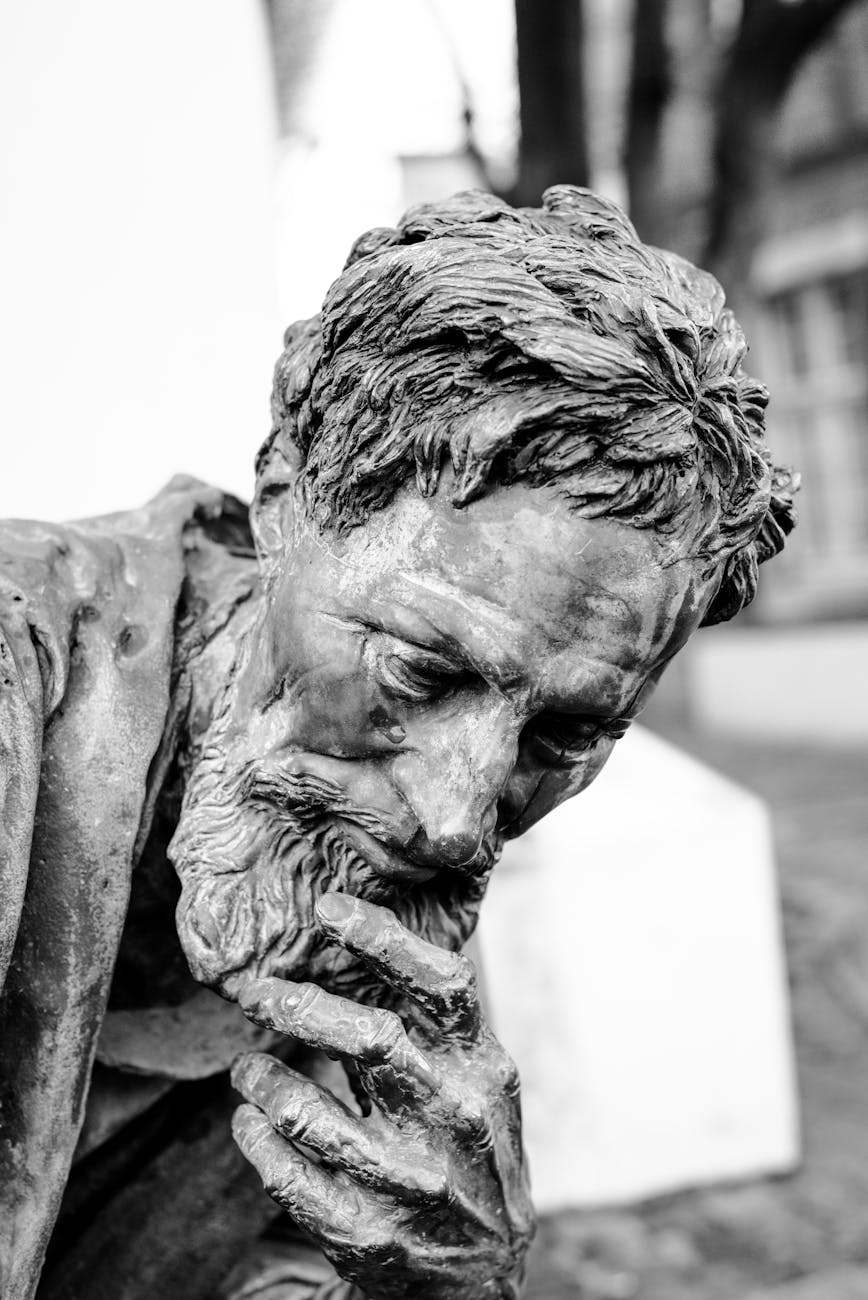
If you could have dinner with any philosopher, who would it be?
Who Was He?
There’s a question people like to ask in interviews and conversations when they want to sound curious:
“If you could have dinner with any philosopher, who would it be?”
For a long time, I thought the question itself was the interesting part.
Which name you choose. What it says about you. Whether you pick someone obvious like Socrates or someone darker, more complex, more intellectual-looking.
But recently, something about the second question stayed with me more.
Who was he?
Not what did he write. Not what school of thought he belonged to. And, not which quotes survived him.
Who was he when no one was listening carefully?
I noticed how quickly the mind turns people into symbols. Especially philosophers. We flatten them into identities we can carry around conveniently. Stoic. Rebel. Mystic. Rationalist. Cynic.
Almost like reducing a human being into a usable tool.
And maybe we do this with everyone.
Not because we’re cruel. Because categories are easier to hold than people.
A philosopher becomes an idea before he remains a person.
I started thinking about how strange it is that we often admire certainty in thinkers who were probably full of confusion privately. We inherit the polished architecture of their thought, but not the unfinished rooms they must have lived inside.
There’s something uncomfortable about that.
Because I realized I do this outside philosophy too.
I remember people by the role they played in my mind. The calm one. The intelligent one. The difficult one. The wise one.
As if a person can be reduced to the most coherent story I can tell about them.
Maybe this is why disappointment feels so sharp sometimes. We meet the actual person after becoming attached to the edited version.
And maybe this is also why public life has become so performative. Everyone senses they are slowly becoming an abstraction in other people’s minds. So they start managing the abstraction instead of living.
A curated self eventually replaces a lived self.
The philosopher becomes “the philosopher.” The writer becomes “the writer.” The thoughtful person becomes someone who only knows how to appear thoughtful.
I don’t think this begins with vanity. I think it begins with repetition.
People reflect an image back to you long enough, and eventually you start protecting it.
What stayed with me about that question wasn’t curiosity about greatness. It was the quiet impossibility of ever fully knowing another person beyond what survived of them.
Imagine sitting across from someone history turned into a monument.
Would they actually speak in profound sentences? Or would they pause awkwardly between thoughts? Would they be attentive? Insecure? Funny in an ordinary way? Exhausted by their own mind?
Would they even resemble the identity built around them after death?
There’s a subtle loneliness in realizing that human beings disappear long before their labels do.
And I think modern life intensifies this.
We consume people through fragments now. Opinions. Clips. Quotes. Profiles. Personal brands.
The distance between a person and their representation keeps widening.
Sometimes I wonder whether we’ve become more interested in readable identities than complicated humans. Complexity slows things down. Labels keep conversations moving.
Even internally, I notice the same habit.
I keep trying to define myself cleanly.
Someone asks who I am, and the mind immediately searches for stable language. But most honest experiences of being alive don’t feel stable at all. They feel shifting, contradictory, unfinished.
Maybe that’s why certain people linger in memory longer than others—not because they were perfectly defined, but because they resisted definition entirely.
There’s also something humbling in realizing how little of anyone survives accurately. A few stories. A few interpretations. And, few preserved sentences.
The rest dissolves.
Not just for philosophers. For all of us.
A part of me finds that unsettling.
Another part finds it strangely relieving.

Maybe being understood completely was never the point.
Maybe the pressure to become a perfectly coherent identity is what quietly exhausts people.
I think I’m beginning to understand that reducing people into ideas is often a way of avoiding the discomfort of their humanity.
A real person is harder to admire cleanly.
They interrupt the narrative.
And maybe that’s why the second question matters more than the first.
Not: Who would you choose?
But: Could you tolerate meeting them as a person instead of a symbol?
Maybe that’s the harder dinner conversation.

Leave a Reply