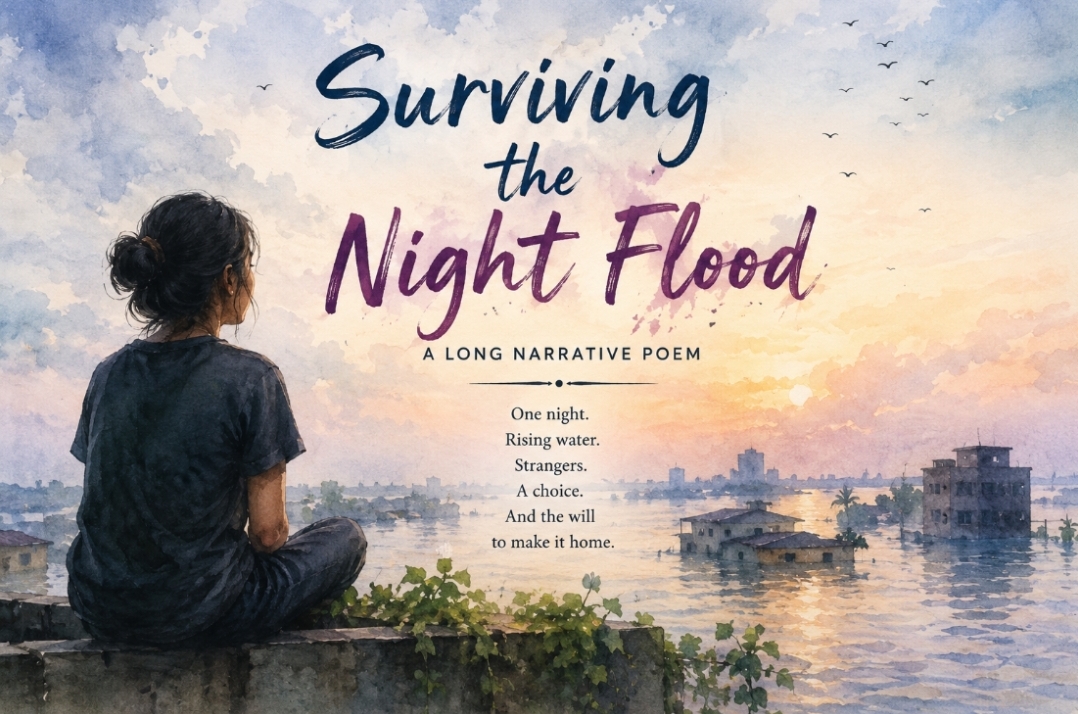
What’s a moment in your life that felt like it was straight out of a movie?
I. BEFORE WATER LEARNS YOUR NAME
There are days memory preserves in careful glass—
birthdays, funerals, exam results,
the smell of new paint in a rented house—
and then there are days memory stores
like wet photographs stuck together,
days that cannot be separated
without tearing.
The evening of Surviving the Night Flood
began badly only in the way
most disasters begin badly:
not enough attention.
I remember checking the sky
while locking the gate.
Not dramatic clouds.
Not the kind cinema prefers.
Just swollen ones.
The lane outside my neighborhood
held its usual inventory:
motorcycles leaning like tired animals,
tea stalls breathing steam,
children inventing games with plastic bottles,
a vegetable seller arguing about coriander,
stray dogs asleep with full confidence
in tomorrow.
Nothing announced itself.
No soundtrack.
No warning text across the screen.
If life had editors,
someone would have inserted music there.
Instead there was traffic.
I had stayed out longer than planned.
The rain had already begun rehearsing.
Not falling.
Testing.
Small drops.
Curious drops.
The kind people wave away
because adulthood trains us
to underestimate everything
that arrives gradually.
My phone battery was low.
My bag was heavier than usual.
I remember these details
because the brain becomes ridiculous
when fear eventually arrives.
It keeps receipts.
At the tea stall someone laughed,
“Roads will drown tonight.”
Everyone laughed back.
Cities teach jokes first
and caution later.
I started walking home.
Streetlights flickered on.
The evening changed color.
And somewhere behind ordinary time,
something enormous
unfastened itself.
II. THE FIRST RISING
Rain has many personalities.
This rain chose violence slowly.
Within thirty minutes
the drains surrendered.
Within forty-five
the roads disappeared.
And, Within an hour
we stopped calling it rain.
We started calling it water.
Water at the ankles first.
Then calves.
Then knees.
The city rearranged itself.
Curbs vanished.
Potholes became traps.
Scooters became islands.
Shopkeepers dragged goods indoors
with the urgency of people
moving memories.
My route home cut through
a low-lying stretch
everyone complains about
and still uses.
I reached it late.
Or maybe the water reached first.
Cars stood dead.
Engines coughed once
and accepted defeat.
People gathered beneath shuttered shops
pretending this was temporary.
Temporary is a dangerous word.
I checked maps.
No signal.
Checked battery.
Eight percent.
Checked sky.
It checked back.
I thought of turning around.
Behind me
water was rising there too.
Ahead
a group moved together.
Crowds create false courage.
I joined them.
That is how many stories begin:
not bravery.
Following.
The current touched my legs differently now.
Not water standing.
Water moving.
Purposefully.
The first moment fear arrived
was not dramatic.
No lightning.
No scream.
Just this:
my foot searched for ground
and failed.
For half a second
I found nothing.
Air above.
Water below.
No certainty between.
A stranger caught my elbow.
“Slow.”
One word.
That word may have saved me.
Movies show survival
as explosions and speeches.
Real survival begins
with instructions no longer than breathing.
Slow.
Hold.
Wait.
Move.
We kept walking.
Rain erased distance.
Every face looked borrowed.
My phone died.
The world became immediate.
I did not know then
that Surviving the Night Flood
would become a phrase
I would repeat for years
to explain why I distrust weather forecasts
and trust strangers more.
III. WHEN THE CITY GOES UNDER
Night arrived too early.
Or perhaps water pulled it down.
Electricity failed section by section.
Buildings vanished into outlines.
The road became rumor.
Someone said a wall had collapsed.
Someone said a bus was stuck.
Elsewhere, Someone said people were trapped near the underpass.
Disaster breeds information
the way darkness breeds shapes.
You stop asking what is true.
You ask what helps.
Water climbed to my thighs.
Then waist.
Cold changes personality too.
At first it is temperature.
Then it is authority.
A child cried somewhere behind me.
A woman shouted names repeatedly.
Someone carried a dog under one arm.
Someone balanced groceries on their head
as if routine itself
could defeat catastrophe.
I remember laughing once.
Not because anything was funny.
Because panic sometimes exits
through the wrong door.
The current strengthened.
A bike floated past.
Not drifted.
Floated.
That Image
That image rearranged something inside me.
Machines are not supposed to float.
Roads are not supposed to move.
Cities are not supposed to become rivers.
Yet there we were—
dozens of us—
walking through a geography
that no longer recognized itself.
We reached a divider.
Held it.
Rested.
Rain hammered metal railings.
I could no longer feel my feet.
Only pressure.
Only force.
Plus, Only the repeated calculation:
next step.
next step.
And, next step.
Across the road—
if roads still existed—
a small shop stood half-submerged.
People climbed onto its raised platform.
We followed.
Water pushed sideways.
Current has hands.
That is the closest description.
Current has hands
and it does not care
who you were before entering it.
Halfway there
my sandal disappeared.
One foot bare.
One not.
An absurd detail.
An unforgettable detail.
The platform held fifteen people.
Then twenty.
Then thirty.
Temporary Species
Rain turned us into a temporary species.
No professions.
No religions.
And, No social categories.
Only soaked humans
performing arithmetic:
How high now?
How long left?
Who has charge?
Who has water?
And, Who is missing?
Someone shared biscuits.
Someone shared a torch.
While, Someone shared rumors.
An old man beside me said,
“I have seen worse.”
I wanted to ask how.
Instead I watched headlights underwater.
Fish would have understood that sight better.
Hours passed strangely.
Time underwater changes shape.
Minutes stretch.
Memories interrupt.
I thought of home.
Of unfinished tasks.
Of messages unsent.
And, Of arguments too small to remember.
Survival edits priorities
with brutal efficiency.
Around midnight
the water rose again.
People stopped talking.
Silence is loud
when everyone shares fear.
This was the moment.
The cinematic one.
The scene directors would slow down.
Rain.
Darkness.
Thirty strangers.
Water climbing stairs.
And my mind saying,
with unbelievable calm:
So this is how movies steal from reality.
IV. SURVIVING THE NIGHT FLOOD
Near one in the morning
someone shouted that rescue boats
were moving nearby.
No one believed immediately.
Hope sounds suspicious
after enough hours.
Then came light.
Far away.
Moving.
Then voices.
Then whistles.
The crowd transformed instantly.
Exhaustion postponed itself.
We waved phones without batteries.
Torches.
Hands.
Cloths.
Anything reflective.
The boat did not come directly.
Too many trapped.
Too many routes blocked.
Waiting returned.
The hardest survival skill
is not swimming.
It is waiting.
Rain Softened
Rain softened briefly.
The city exhaled mud.
I looked down.
Water carried leaves, bottles, slippers, branches,
someone’s broken bucket,
someone’s lost photograph perhaps.
Disaster collects objects
without permission.
At around two
the current near the platform changed.
Stronger.
Angrier.
Water entered the shop completely.
The owner watched shelves disappear.
He said nothing.
Some losses arrive
too fast for language.
When rescue finally reached us,
it was smaller than expected.
Not hero-sized.
Just tired people
doing repeated work.
“Women first.”
“Children first.”
Classic instructions.
Ancient instructions.
Necessary instructions.
I waited.
Not from courage.
From mathematics.
There was no space.
On the second trip
my turn came.
Climbing into that boat
felt less like victory
and more like negotiation.
Water grabbed at legs.
Hands pulled from above.
For a second
I was suspended between both.
Then inside.
People sat silently.
No cheering.
No applause.
Only breathing.
The boat moved through roads
I had walked for years
without imagining depth.
Balconies became landmarks.
Traffic lights became islands.
Signboards floated above water
advertising normal life.
I remember one cinema poster
half-submerged.
Even then
my brain noticed irony.
The ride lasted maybe twenty minutes.
Memory says hours.
We reached higher ground.
Volunteers handed blankets.
Tea.
Instructions.
Questions.
Names.
Phones.
Networks returned slowly.
Messages exploded.
Where are you?
Are you safe?
Call back.
Reply.
Please reply.
I typed:
“I’m okay.”
Three words.
Too small for the night.
The phrase Surviving the Night Flood
first formed in my head there.
Not as poetry.
Not as meaning.
As inventory.
I survived.
It was night.
There was flood.
Facts first.
Understanding later.

V. AFTER THE CREDITS ROLL
Morning after disaster
is visually offensive.
Because sunlight behaves normally.
Because birds continue.
And, Because vendors reopen.
Also, Because the world refuses
to match your internal weather.
I returned home by afternoon.
Mud everywhere.
Furniture swollen.
Walls marked with brown lines
showing where water had negotiated.
Neighbors exchanged stories
like survivors always do.
Measured losses.
Compared timings.
Counted luck.
For weeks afterward
every heavy rain
sounded personal.
I checked drains obsessively.
Charged power banks.
Stored emergency numbers.
Not because fear remained.
Because knowledge had arrived.
People ask sometimes:
“What was the scariest part?”
Not water.
Not darkness.
In fact, Not thinking I might disappear.
The scariest part
was realizing how quickly
ordinary life resigns.
One hour you are discussing vegetables.
Next Hour
Next hour
you are calculating buoyancy.
People ask:
“Did it feel like a movie?”
Yes.
And no.
Movies end cleanly.
Real survival lingers.
It appears unexpectedly—
when stepping into deep puddles,
when hearing rain at 2 a.m.,
And, when seeing news footage,
when finding that single sandal’s replacement
months later in a market
and staring too long.
Surviving the Night Flood
became a story others enjoy hearing.
For me
it remains a physical language.
My knees remember currents.
My hands remember railings.
And, My ears remember rain hitting metal.
There is another thing survival changes:
you become aware
of invisible architecture.
The stranger who caught my arm.
The platform owner.
The volunteers.
The rescue crew.
The person sharing biscuits.
The voices in darkness saying,
“Hold here.”
“Careful.”
“One more step.”
We survive disasters
using other people’s verbs.
Sometimes at night
during storms
I stand near windows.
Not from fear.
From respect.
Clouds gather.
Roads shine.
Water begins rehearsing.
And somewhere inside me
the old film projector starts again:
a city underwater,
headlights beneath currents,
strangers becoming temporary family,
and a version of me
walking carefully through waist-high uncertainty
toward a morning
he had not yet earned.
That night taught me
survival is rarely cinematic
while it is happening.
Cinema comes later.
In retelling.
In pauses.
And, in selective memory.
In titles.
In poems.
So, In the way I still say
Surviving the Night Flood
not because it sounds dramatic—
but because some nights
rename you.
And once renamed,
you spend years
learning how to answer
to the person
who came back.

Leave a Reply