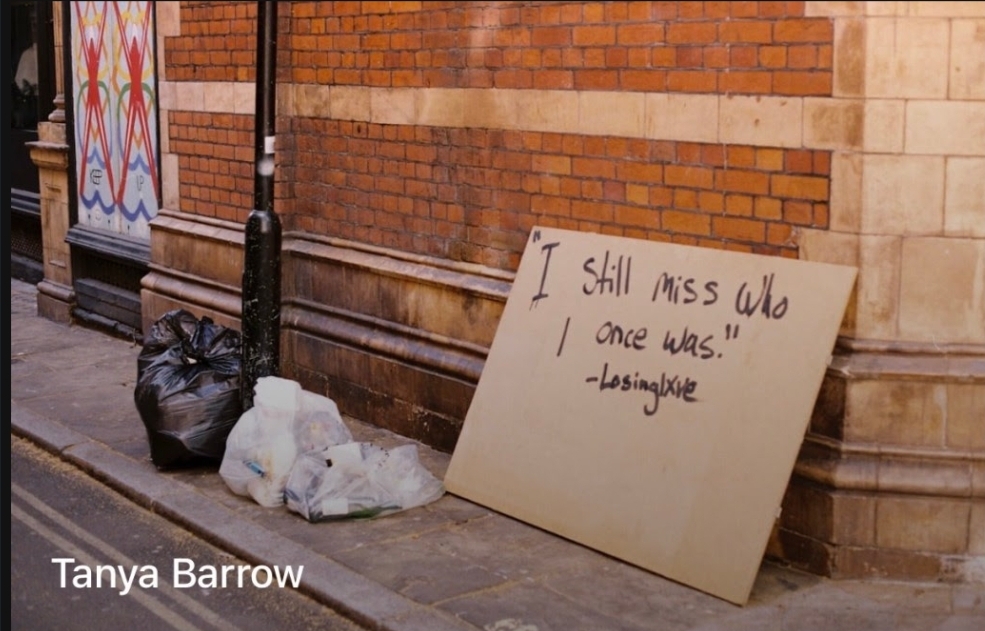
Sometimes emotional collapse does not arrive dramatically. Sometimes it appears on a pavement, handwritten on cardboard beside black bags waiting for collection.
This I Still Miss Who I Once Was Poem explores how people mourn former versions of themselves while continuing the uncomfortable work of becoming.
I Still Miss Who I Once Was
Pavement Theology
On a narrow street
where buildings carried soot
the way old memories carry fingerprints,
someone left grief
leaning against brick.
Not framed.
Not edited.
And, Not curated for kindness.
Just cardboard.
Just marker ink.
And, Just a sentence heavy enough
to bend morning.
I still miss who I once was.
And beside it—
rubbish bags.
Because cities understand symbolism
better than poets sometimes.
Because loss
often waits near disposal.
And, Because maybe
we throw away pieces of ourselves
without noticing.
The pale morning sky
hung above rust-orange brick.
Double yellow lines
ran beside the pavement
like warnings nobody follows.
Wind pushed wrappers
against drains.
A pigeon pecked at something invisible.
The city continued.
It always does.
Inventory of Former Selves
I miss the version of me
that believed calendars meant progress.
The version
who bought notebooks
thinking blank pages were guarantees.
The one
who answered unknown numbers.
The one
who slept easily.
And, The one
who thought emotional healing
would look cleaner.
I miss old ambitions
with polished shoes.
Old laughter
before it learned economics.
Old friendships
before geography won.
And, Old confidence
before mirrors became negotiations.
And if I am honest—
some of those people
were difficult.
Some were frightened.
And, Some were pretending.
Still.
Grief is strange.
It waters weeds too.
The Cartography of Identity Loss
Identity loss
does not arrive with sirens.
It arrives through smaller thefts.
You stop recognizing music.
You stop calling friends.
Your laugh sounds borrowed.
You say
“I used to…”
too often.
You discover entire months
missing from memory.
Then, You search photographs
like archaeological sites.
You hold bus tickets
from years ago
as evidence.
You keep passwords
for versions of yourself
that no longer exist.
Finally, You wonder:
Who left first—
me
or time?
No answer.
Only timestamps.
City Lessons
Cities teach quietly.
Through overflowing bins.
Through pigeons.
While Through convenience stores open at 2 a.m.
Through cigarette ends
floating through gutters after rain.
Through strangers smoking
beneath scaffolding
like temporary architecture.
Every street says:
Nothing stays.
Not businesses.
Not relationships.
No, Not hairstyles.
Not certainty.
Brick darkens.
Paint peels.
Windows change tenants.
People rehearse permanence
inside temporary rooms.
And still—
every morning
someone buys coffee.
Someone catches a bus.
And, Someone decides to continue.
Small Urban Miracles
Rain collected
inside pavement cracks.
Tiny rivers
with nowhere important to go.
I watched them anyway.
A woman tied her shoelace
using a bus-stop bench.
A delivery rider
fed half his biscuit
to a stray dog.
A leaking pipe
created music
against metal.
Someone somewhere
opened curtains.
Someone somewhere
closed a chapter.
Life continued performing
its unimpressive miracles.
Quietly.
Repeatedly.
Without audience.
Mindfulness for the Broken Familiar
The mindfulness books said:
Observe.
Breathe.
Return to the moment.
Fine.
So I observed:
Wet concrete.
Coffee stains.
Torn posters.
Moss inside cracks.
A cigarette filter.
Rust running down drainpipes.
My reflection
fragmented in puddles.
I breathed.
The city inhaled too.
Exhaust fumes.
Street food.
Rainwater.
Dust.
Memory.
I returned to the moment.
It was messy.
Still there.
Still enough.
Dialogue with Former Versions
I invited old selves
to sit beside me.
The ambitious one arrived first.
Still impatient.
Still overdressed.
Then teenage me.
Suspicious.
Loud.
Embarrassed by tenderness.
Then the exhausted version.
The survival version.
The grieving version.
The version
who stayed
when easier options existed.
They crowded the room.
None wanted apologies.
None wanted speeches.
Only acknowledgment.
So I said:
You existed.
You mattered.
And, You carried me here.
Weather Systems
People think transformation
looks like sunrise.
Mostly—
it looks like weather.
Clouds gathering slowly.
Pressure changing.
A storm
you only understand
after furniture moves.
There were winters
inside crowded rooms.
Springs
that arrived late.
Entire years
spent in emotional fog.
Invisible climbing.
Invisible mountains.
And, Invisible work.
Yet somewhere—
roots continued.
Invisible work counts too.
Streetlight Philosophy
Under orange streetlights
everyone becomes softer.
Edges blur.
Regret becomes architecture.
Hope becomes practical.
A man swept storefront dust
into smaller dust.
A train passed overhead.
Someone laughed loudly enough
to interrupt despair.
I remembered:
Meaning rarely arrives dramatically.
It hides in repetition.
In routines.
In washing cups.
And, In answering messages.
In returning home.
In continuing.
Urban Ecology
Even rubbish bags
serve purpose.
Even discarded cardboard
holds messages.
And, Even cracked pavements
grow weeds.
Cities understand composting.
Why don’t we?
Old selves decompose too.
They feed future versions.
Nothing beautiful grows
without breakdown.
Old identities
do not disappear.
They become soil.
What the Brick Wall Saw
That wall probably witnessed:
Arguments.
First kisses.
Deliveries.
Breakups.
Drunken songs.
Loneliness.
Rain.
Years.
And now—
this sentence.
I still miss who I once was.
Brick said nothing.
Witnesses rarely do.
Still—
it remained standing.
There is instruction in that.
The Turning Point
I stopped asking:
How do I become old me again?
I started asking:
What survived?
Curiosity survived.
Humor survived.
Kindness survived.
Stubbornness definitely survived.
So did wonder.
So did longing.
Enough remained
to continue construction.
And maybe—
grief itself
was proof.
Because only living things mourn change.
Closing Inventory
Today I own:
Different dreams.
Different fears.
And, Different posture.
Different definitions of success.
I no longer fit
inside previous versions.
That hurts sometimes.
Freedom often does.
But if I passed that pavement again—
the cardboard.
The rubbish bags.
The quiet street.
The unfinished winter air.
I would write underneath:
I miss who I once was too.
And I am learning
to miss them
without abandoning myself.
Because becoming
was never replacement.
Only accumulation.
Because old selves
do not disappear.
They become foundation.
Because the city keeps moving.
Because morning returns.
And, Because somewhere
another person
will see a sentence on cardboard
and realize—
they are not the only one
carrying ghosts gently.
This poem explores identity grief—the emotional experience of mourning versions of ourselves that through age, burnout, success, failure, illness, responsibility, or simple time. The cardboard sign functions as a public confession in an impersonal space.
Practically, the poem suggests emotional healing may not come through dramatic reinvention. Often it appears through routine, observation, and allowing old selves to remain part of the story rather than enemies of it.


Leave a Reply