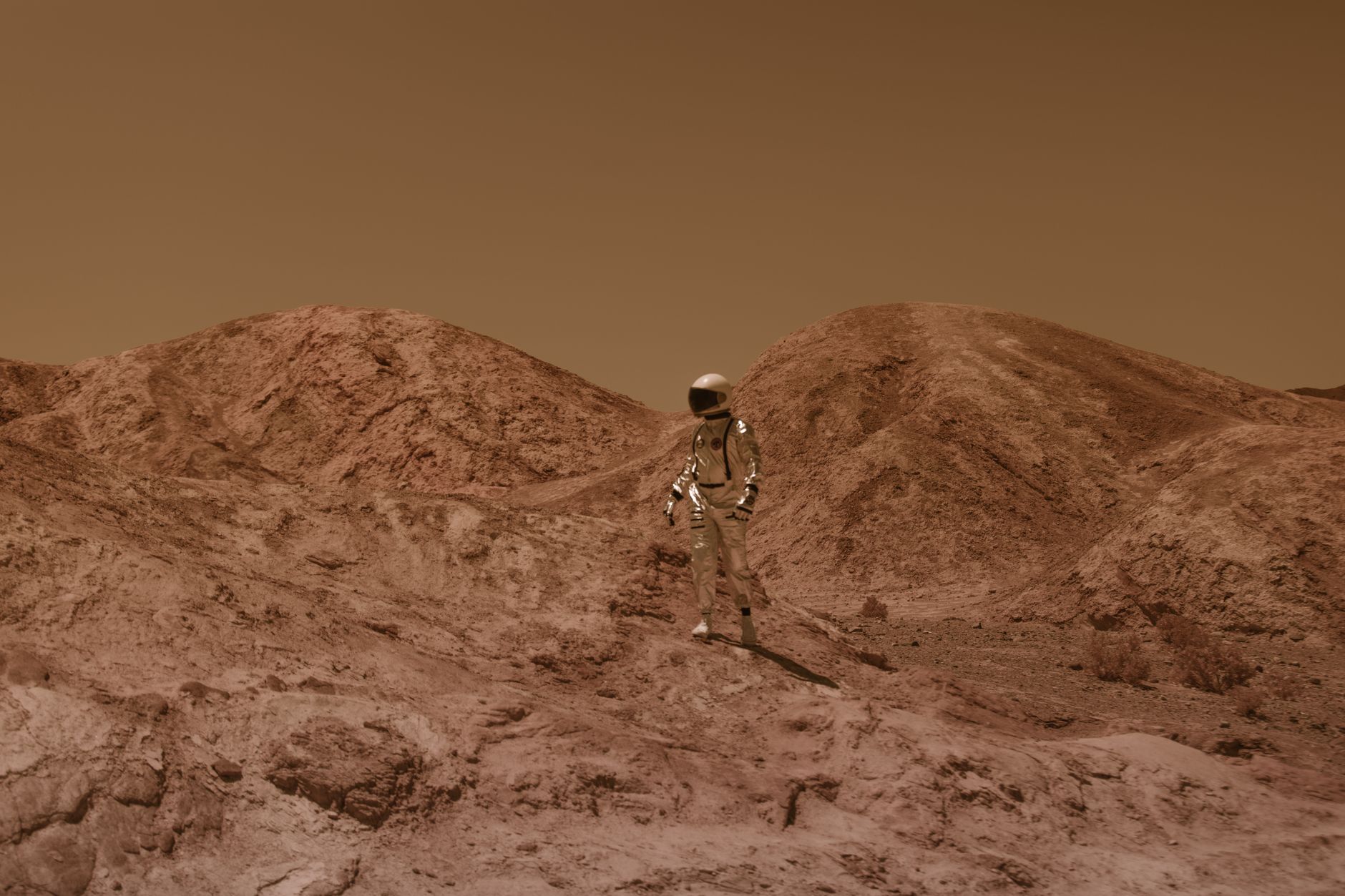
Do you think humans will ever colonize Mars? What would life there actually look like?
Human Colonization of Mars
The question of whether humans will colonize Mars is not merely a technological question. It is a philosophical one.
Mars stands before us as both destination and mirror.
For thousands of years humanity has looked toward distant horizons. Oceans were crossed. Mountains were climbed. Deserts were traversed. Every frontier seemed impossible until someone stepped into uncertainty and transformed it into a map.
Yet Mars introduces a deeper contradiction.
The planet is lifeless—or nearly so—and still we dream of calling it home.
Why?
Perhaps because colonizing Mars is not only about escaping Earth. It is about understanding ourselves. The impulse to reach another world reveals something ancient within the human spirit: an unwillingness to remain confined by present boundaries.
But there is tension here.
We seek another planet while struggling to care for the one that gave us life.
We imagine cities beneath Martian soil while forests disappear on Earth.
Moreover, we dream of future generations beneath alien skies while many people remain disconnected from one another beneath familiar skies.
Mars therefore becomes both hope and warning.
Emotionally, the theme contains loneliness and wonder in equal measure.
A human standing on Mars would be farther from Earth than any person has ever been. The blue world would become a distant star-like object. Every memory of rain, oceans, birds, forests, and wind would acquire sacred significance.
The journey would enlarge human possibility while intensifying human homesickness.
Mars asks an enduring question:
Can humanity carry its humanity into the cosmos?
Or do we merely transport our ambitions, fears, and divisions across greater distances?
Perhaps colonization is not ultimately about inhabiting Mars.
Perhaps it is about learning how to inhabit existence itself with greater wisdom.
Do You Think Humans Will Ever Colonize Mars? What Would Life There Actually Look Like?
At first glance, Mars appears to be a scientific challenge—a destination awaiting rockets, habitats, and engineering solutions. Yet beneath the technological ambition lies a much older story. The dream of Mars is the latest expression of humanity’s enduring relationship with the horizon.
Every age has imagined a place beyond the known world.
Ancient sailors looked toward the edge of the sea. Explorers crossed deserts and mountain ranges. Astronomers lifted their eyes toward distant stars. Mars continues that pattern. It is not merely a planet; it is a symbol of the human desire to move beyond limitation.
The deeper philosophical question is not whether we can reach Mars, but why we feel compelled to try.
Perhaps humans are creatures who cannot remain entirely satisfied with what is already known. Curiosity seems woven into our nature. We build maps not only to understand the world but also to understand ourselves. Every frontier becomes a mirror.
A Destination and a Reflection
Mars, therefore, is both a destination and a reflection.
It reflects our ingenuity, our courage, and our willingness to imagine futures that do not yet exist. Yet it also reflects our uncertainties. Why do we seek another home while struggling to protect the one we already have? Why does the dream of another world grow stronger even as many people feel disconnected from their own communities and landscapes?
Within this theme lives a profound contradiction.
Mars may become humanity’s greatest act of expansion and simultaneously a reminder of Earth’s irreplaceable beauty.
The first settlers on Mars would likely live beneath the surface, sheltered from radiation and extreme temperatures. Their days would be structured around survival. Water would be precious. Air would be carefully managed. Food might grow under artificial lights in enclosed gardens. Outside the habitat would stretch a vast silence unlike anything experienced on Earth.
This imagined life contains both wonder and loneliness.
A person on Mars could look into the sky and see Earth as a distant blue point. Everything familiar—oceans, forests, rivers, rainstorms, birdsong, seasons—would be compressed into a tiny light among countless others.
Distance has a Way
Distance has a way of transforming ordinary things into treasures.
The colonist might miss the feeling of wind against bare skin. The scent of wet soil after rain. The effortless abundance of a living planet. Things often overlooked on Earth could become sacred memories on Mars.
Emotionally, the theme exists between hope and homesickness.
Hope, because humanity would have extended life beyond a single world.
Homesickness, because every step away from Earth would deepen awareness of what Earth provides.
There is also a tension between survival and meaning.
Technology may solve the practical problems of living on Mars. Habitats can be built. Water can be recycled. Crops can be cultivated. Yet a deeper question remains: what transforms survival into a fulfilling human life?
People need more than oxygen and calories.
They need stories.
They need beauty.
And, they need belonging.
Engineers and Scientists
A Martian settlement would not merely require engineers and scientists. It would require artists, teachers, gardeners, musicians, and dreamers. It would require culture. Without culture, a colony might survive but never truly become a civilization.
Another philosophical layer emerges when considering identity.
What happens when children are born on Mars?
Would they consider Earth their ancestral homeland or a distant myth?
Would they feel connected to rivers they have never seen, forests they have never walked through, or rain they have never felt on their faces?
The first generation of Martians may inhabit two worlds simultaneously—one physical and one remembered.
This creates a poignant image: humanity carrying Earth inside itself while living somewhere else.
Ultimately, the theme suggests that Mars is not merely about colonization.
It is about the nature of home.
It asks whether home is a place, a memory, a relationship, or a feeling.
And, it asks whether humanity’s greatest journey is outward into space or inward into deeper self-understanding.

Perhaps the most important insight is this:
If humans eventually build cities beneath Martian soil, the achievement will not simply demonstrate technological mastery. It will reveal something fundamental about the human condition. We are a species that stands beneath the stars, aware of our fragility, aware of our limitations, and yet continually willing to imagine a future beyond them.
Mars represents the meeting point of ambition and humility.
We dream of another planet because we are restless.
We hesitate because we know what might be lost.
And somewhere between those two impulses—the urge to leave and the longing to belong—the true heart of the theme begins to emerge.

Leave a Reply