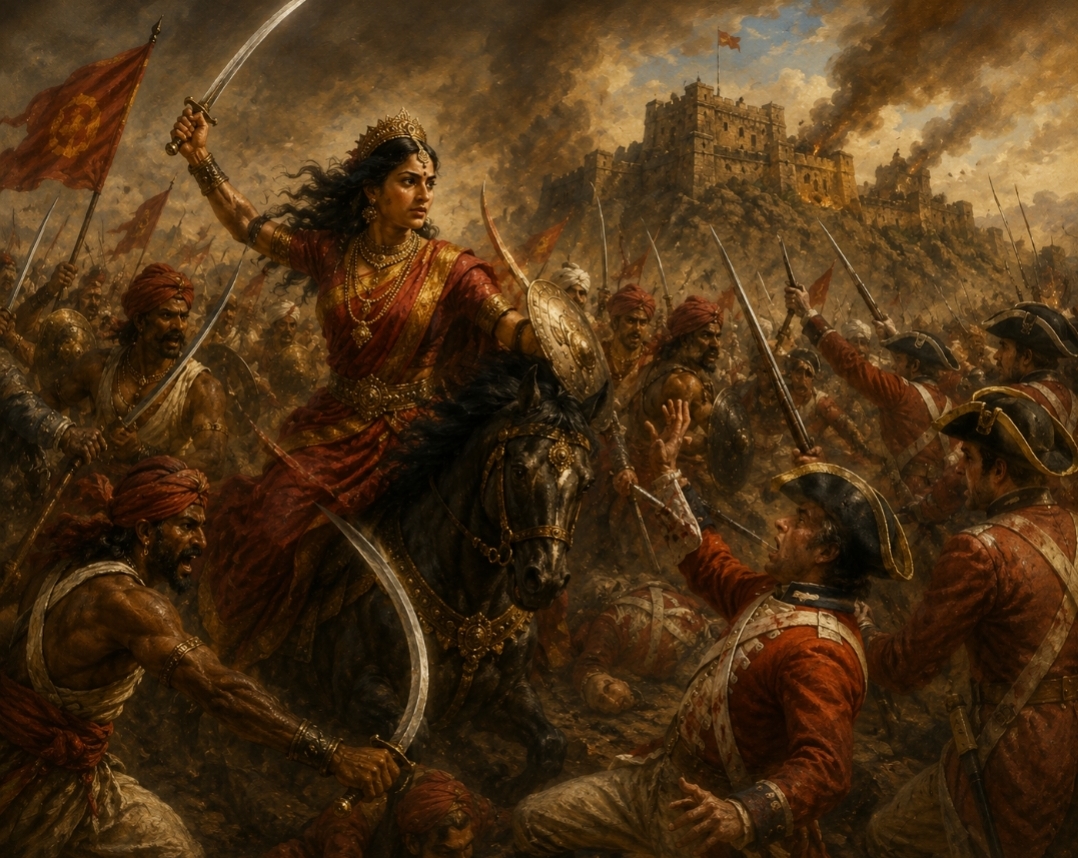
This article explores the life of Veeramangai Velu Nachiyar, the Queen of Sivaganga who remains a cornerstone of South Indian history. Born in 1730, she was a master of martial arts and a scholar of multiple languages, skills she utilized to orchestrate a massive counter-offensive against colonial forces.
Her story is an emotional bridge between personal loss and national duty. From the sacrifice of her husband to the heroic martyrdom of her aides, Kuyili and Udaiyal, her path to reclaiming her kingdom in 1780 serves as a testament to the power of female leadership and grassroots loyalty.
Born in 1730, the Queen grew like a prince and trained extensively in martial arts, including sword fighting, archery, spear throwing, horse riding, and the use of weapons like the Valari and Silambam.
1772 Attack on Sivaganga
Following the 1772 attack on Sivaganga where her husband was killed, Velu Nachiyar spent eight years in exile in the Dindigul region (specifically Virupakshi) under the protection of Gopal Nayak. It was in Dindigul that she met with Hyder Ali to secure the military alliance—including 5,000 cavalry and 5,000 infantry—needed to reclaim her kingdom.
Standing beside her would be Periya and Chinna Marudhu, who escaped the initial slaughter with her and served as her most dependable commanders and ministers during the rebellion.
The “faint glow of fire” represents the turning point of the 1780 battle. Her commander, Kuyili, doused herself in ghee, set herself ablaze, and jumped into the British ammunition storehouse, destroying their weaponry and enabling the Queen’s victory.

The article emphasizes that Velu Nachiyar’s victory was not hers alone; it was a collective effort of diverse allies—from the Sultan of Mysore to a humble cowherd girl. It frames her not just as a victim of colonial expansion, but as a proactive strategist who waited eight years for the perfect moment to strike.
In modern times, her legacy teaches the importance of building alliances and the necessity of resilience. Her “Udaiyaal” army reminds us of the long history of women’s active participation in political and military struggles.
Veeramangai: The Saga of Velu Nachiyar
I. The Royal Dawn: A Prince in a Princess’s Guise
In the year seventeen-thirty, under the Ramanathapuram sun, A child was born to Raja Chellamuthu, the Sethupathy line’s only one. No male heir walked the palace halls of the Ramnad king, So they raised the Princess Velu like a prince, a warrior in the wing. She did not only learn the grace of silk and courtly dance, But mastered the Valari and the bow, leaving nothing to chance. In Silambam stick fighting, her movements were a rhythmic blur, And the thunder of galloping horses was a song that well to her. While others studied embroidery, she studied the art of the blade, Mastering spear throwing and archery in the banyan tree’s shade.
But the steel of her mind was sharper than any iron she held, As she conquered the tongues of the world, her intellect unquelled. French, English, and Urdu flowed from her lips with sovereign ease, A scholar-queen preparing for a storm that would sail across the seas. She read the ancient Sangam works, the Silappadhikaram’s deep lore, Knowing well that a crown is a burden, a duty, and a war.
II. The Crimson Temple: The Slaughter at Kalaiyar Koil
At sixteen, she wed Muthu Vaduganatha, the king of the Sivaganga soil, A union of two ancient houses, a respite from the coming turmoil. But the British East India Company cast a long and greedy shadow, Aiming to turn the fertile fields of the south into a colonial meadow. In seventeen-seventy-two, the air turned heavy with the scent of lead, As the Nawab of Arcot and the British troops moved with a silent tread.
Under Lieutenant Colonel Bon Jour and the cunning of Colonel Smith, They struck at the heart of the kingdom, ending the peace and the myth. At the sacred Kalaiyar Koil palace, the guns of the Company roared, And there, the King Muthu Vaduganatha fell beneath the foreign sword. The palace floors had stains with the blood of the righteous and the brave, As the invaders were seeking to turn a sovereign throne into a pauper’s grave. Velu Nachiyar, now a widow, did not succumb to the dark of despair, But fled with her daughter Vellachi through the smoke-choked air. Beside her stood the Marudhu brothers, loyal as the earth and sky, Vowing that the flame of Sivaganga would never, truly die.
III. The Silence of the Hills: Eight Years in the Wild
Into the green sanctuary of Virupakshi, the Queen retreated in the night, Seeking asylum with Gopal Nayak, away from the Company’s sight. For eight long years, she lived as a ghost in the Dindigul hills, Her heart a forge of cold resolve, her spirit a fire that never chills. She did not spend her exile in mourning or in quiet, hollow prayer, But built a network of spies and scouts, breathing the rebel’s air. She watched from the heights of Dindigul, where the winds whisper of the past, Knowing that a queen who waits is a queen whose victory will last.
Every day she practiced the Valari, her aim more deadly than before, Thinking of the stolen palace and the husband she would see no more. Beside her, the Marudhu Pandiyar brothers gathered the scattered men, Preparing to reclaim the red soil of the south from the lion’s den. They moved through the deep jungles of Thiruverkadu, unseen and fleet, Planning the guerrilla strikes that would bring the Company to its feet.
IV. The Tongue of Diplomacy: The Alliance with Mysore
In Dindigul, the Queen requested a meeting with the Sultan of the West, To see if Hyder Ali of Mysore would put her grievances to the test. She did not come with a translator, or with a humble, bended knee, But spoke to the Sultan in his own Urdu, a language of the free. She described the treachery of the Nawab and the British Company’s greed, Presenting her cause with the logic and the fire that the moment decreed. Hyder Ali looked upon this warrior queen and saw a mirror of his own aim, Admiring the intellect that spoke his tongue and the heart that sought no fame.
“I will give you my support,” the Sultan said, his decision swift and grand, “Five thousand cavalry and five thousand infantry to take back your land”. He ordered Syed Karki of Dindigul to provide the weapons they would need, Sowing the iron seeds of a rebellion that would surely succeed. With the Mysore alliance secured, the Queen began to march once more, A coalition of the oppressed, ready to settle the bloody score.
V. The Shepherd’s Vow: The Sacrifice of Udaiyal
While the Queen was a fugitive, hiding from the British search and snare, A young cowherd girl named Udaiyal was caught in the lion’s glare. She was only twelve years old, a child of the goats and the peepal tree, But she held within her a secret that would keep the Queen’s spirit free. The British soldiers demanded to know where the hidden Queen had gone, Threatening the child with the steel of the sword before the break of dawn.
Udaiyal stood silent, her lips a locked gate against the foreign breath, Choosing the honor of her land over the hollow bargain of death. They executed her there, a martyr before she had truly begun to live, Giving more to the cause of Sivaganga than any soldier could ever give. When Velu Nachiyar came to know of the girl refusing to betray her name, She vow that she will turn Udaiyal’s silence into an eternal flame. She established the Udaiyal Padai, an army of women fierce and strong, Naming them after the shepherdess who righted the ultimate wrong. At the site of the martyrdom, she raised a hero stone, a Veera Kal, A temple for the girl who saved the Queen and the hopes of them all.
VI. The Gathering Storm: The Marudhu Brothers and the Advance
The Marudhu brothers, Periya and Chinna, led the vanguard of the fight, Commanders of the Queen’s own will, moving in the dead of night. Periya Maruthu, the elder, born in seventeen-forty-eight, A master of the sword and the Valari, challenging the hand of fate. Chinna Maruthu, the younger, the diplomat with the rage-filled eyes, Whose words could unite the castes of the south beneath the rebel skies. They moved like the monsoon wind, clearing the hurdles the Nawab had set, Reminding the people of Sivaganga of the debt they had not paid yet.
Through the red soil of the south, the combined forces began to swell, From the peasants in the fields to the nobles who knew the palace well. They employed guerrilla tactics, striking where the British felt most secure, Making the cost of the occupation more than the Company could endure. The Queen rode at their head, her sari tucked like a soldier’s gear, Her presence a banner of hope that banished every lingering fear.
VII. The Human Flame: Kuyili’s Final Act
The year was seventeen-eighty, the feast of Vijayadashami was near, The time when the Goddess defeats the demon and banishes all fear. The British fort at Sivaganga was a fortress of iron and stone, Housing the ammunition that kept the Company on its stolen throne. Kuyili, the Dalit commander of the Udaiyal Padai’s ranks, Proposed a plan that would earn her the nation’s eternal thanks. On the day of the festival, when women were allowed inside the gate, The Udaiyal army entered the fort, carrying the heavy hand of fate. Kuyili drenched her body in the ghee of the temple lamps, a sacred oil, Preparing to end the British reign and the years of colonial toil.
She climbed the ramparts, a human torch, and dived into the store, Igniting the British ammunition with a deafening, righteous roar. The first suicide bomber in the history of the freedom struggle’s fire, She turned her own life into a weapon, a funeral and a pyre. In that blinding flash, the British muskets were rendered cold and still, Leaving the fort to be taken by the Queen’s own iron-tempered will.
VIII. The Hanuman Flag Rises: Victory and the Return
The Nawab’s flag was lowered from the Sivaganga palace walls at last, A symbol of a decade of darkness that was now firmly in the past. Under the reign of Velu Nachiyar, the Hanuman flag was hoisted high, Fluttering in the southern breeze against a free and open sky. She was crowned the Queen once more, the first to defeat the British hand, Restoring the honor of the Sethupathys and the dignity of her land.
For sixteen years she ruled, a pioneer of the welfare state, Ensuring that her people’s needs were never left to cruel fate. She gave the Marudhu brothers the power to manage the kingdom’s day, While she worked to ensure the British would forever stay away. She built mosques and churches to honor the support that Hyder Ali gave, A queen of all communities, a ruler as wise as she was brave. Her administration was a testament to the power of a woman’s lead, Sowing the seeds of resistance for every future revolutionary’s need.
IX. The Eternal Veeramangai: Legacy Beyond the Grave
In seventeen-ninety-six, on the twenty-fifth of December, she passed away, Leaving a legacy of fire that still burns in the Tamil heart today. She was the “Veeramangai,” the brave woman of the southern soil, The first to show the world that the Company’s plans could foil. Eighty-five years before the Rani of Jhansi took up her famous stand, Velu Nachiyar had already reclaimed her crown and her native land. Though history textbooks once forgot the Queen who waited eight long years, The folk songs of Sivaganga kept her story alive through the tears.
In two-thousand-eight, the nation honored her with a postage stamp’s grace, Ensuring that the modern world would finally look upon her face. Statues now stand in Chennai and Sivaganga, life-size and grand, Symbols of the warrior queen who led the first resistance in the land. The Police Training School in Vellore now carries her sovereign name, An institutional memory of her courage and her undying flame. She remains the hero stone, the deity under the peepal tree, The Queen who taught an empire what it means to truly be free.
Personal Loyalty and Espionage
Beyond her final sacrifice, the sources highlight that Kuyili was a constant protector of the Queen. She was a sevaki (loyal aide) who saved Velu Nachiyar’s life on multiple occasions, including once when she discovered the Queen’s Silambam teacher was actually a spy. On another occasion, she fended off an attacker while the Queen was sleeping, injuring herself in the process. These acts of individual bravery led to her appointment as the commander of the all-women army. Furthermore, Velu Nachiyar is credited with establishing a detailed espionage network that gathered critical information on British military plans, which was essential for her strategic victory in 1780.
The International Connection
One of the most intriguing details mentioned in the sources is the possibility that Velu Nachiyar traveled far beyond India for her health. Following the mysterious death of her daughter, she suffered from a severe heart ailment. A bishop named Jose-de-pray reportedly arranged for her to receive medical treatment in France. While not fully confirmed, it is presumed she may have been in Paris in 1791 before returning to Sivagangai three years later.
Family Tragedy and Succession
The Queen’s later years were marked by significant personal loss and political compromise:
- Mysterious Death: Her only daughter, Vellachhi Nachchiyar, died under mysterious circumstances in 1790, which caused the Queen tremendous mental stress and led to her physical decline.
- Succession Compromise: Following her death, the British imposed a “compromise formula” for the throne. Vengan Periya Udaya Thevar became the king of Sivagangai, while Velu Nachiyar’s adopted son, Padamathur Gowri Valluba Thevar, had to flee to Arantangi to protect his life.
The Pan-Indian Vision of Her Commanders
The legacy of her top commanders, the Marudhu brothers, extended into a broader vision for India. In June 1801, months before their own execution, they issued the Tiruchi Proclamation from the Tiruchi fort. This was a revolutionary document that called for people of all castes and communities to unite against European domination. It was one of the earliest expressions of an “all-Indian concept” of independence, warning that if the “political malady” of British rule persisted, the entire country would fall under alien rule.
Religious and Cultural Legacy of Udaiyal
The story of the 12-year-old martyr Udaiyal (or Ummai Udaiyal) is immortalized in local worship. The sources note that Velu Nachiyar founded the Vettudaiyal Kaliyamma temple at the exact spot of the girl’s execution. The name “Vettudaiyar” comes from the Tamil word vettudai, meaning “cut with a machete,” referring to the manner of her death. To this day, local people worship her as a deity and the site features a Veera Kal (hero stone) erected by the Queen.

Leave a Reply