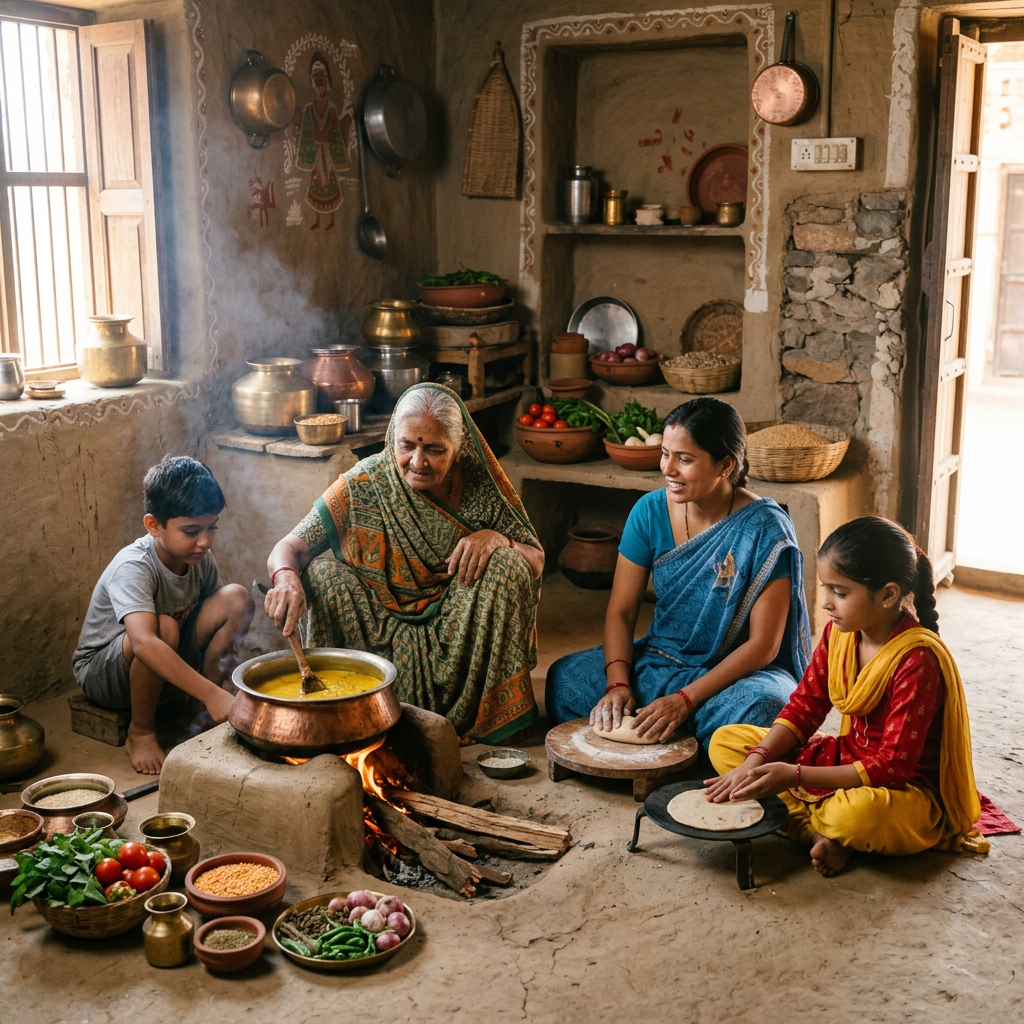
When a Recipe Disappears, a Memory Goes Silent
Why traditional food habits are disappearing globally is not just a cultural concern—it is a quiet psychological shift happening inside homes, kitchens, and everyday routines. You notice it not when a dish vanishes, but when no one remembers how it was made.
A recipe forgotten is not just an absence of taste. It is an absence of context. Of stories. Of people.
And most importantly, of continuity.
The Shift From Inherited Knowledge to Convenient Consumption
For most of human history, food was not chosen—it was inherited.
What you ate depended on geography, seasons, and generational memory. Recipes were not written; they were absorbed. Cooking was less about precision and more about participation.
Today, that system has collapsed into choice.
Supermarkets replaced soil. Algorithms replaced elders. Convenience replaced continuity.
The question of why traditional food habits are disappearing globally begins here: when food becomes a decision rather than a legacy, it becomes vulnerable to replacement.
Efficiency Is Quietly Rewriting Cultural Memory
Modern food systems are engineered for efficiency—long shelf life, standardized taste, scalable production. This is not accidental; it is optimization.
But optimization has a cognitive cost.
Traditional cooking is inefficient by design. It requires time, attention, and tacit knowledge. It involves judgment, improvisation, and sensory awareness. These are not easily scalable.
So the system does what systems do—it eliminates friction.
In doing so, it eliminates memory.
Because memory thrives in friction.
When Food Stops Being a Process and Becomes a Product
A traditional dish is not just the final output—it is the process behind it. The sourcing, the preparation, the waiting, the adjustments.
Industrial food collapses all of this into a product.
You no longer make food. You select it.
And in that shift, something fundamental changes: your relationship with food becomes transactional rather than participatory.
This is a key reason why traditional food habits are disappearing globally—because habits require repetition, and repetition requires involvement.
Convenience removes involvement.
The Disappearance of Food Is Actually the Disappearance of Time
At its core, this is not about food. It is about time allocation.
Traditional cooking demands time blocks that modern life resists. Long preparation cycles, slow cooking methods, seasonal dependencies—these do not align with fragmented schedules and digital attention spans.
So the system adapts.
Quick recipes. Ready-to-eat meals. Food delivery ecosystems.
But here’s the paradox: as time-saving increases, experiential richness decreases.
And humans begin to consume more, but experience less.
Globalization Expands Choice but Compresses Identity
Globalization is often framed as abundance—and it is. You can eat anything, anywhere, anytime.
But abundance has a hidden side effect: dilution.
When everything is available, nothing is anchored.
Local cuisines once acted as identity markers—distinct, rooted, specific. Now, they compete with global formats designed for mass appeal.
Pizza, burgers, noodles—these are not just foods. They are optimized cultural exports.
They travel well. Plus, they standardize easily. Above all, they require minimal contextual knowledge.
Traditional foods do not.
And in that mismatch, they lose.
Why Preservation Efforts Often Miss the Real Problem
Attempts to preserve culinary heritage often focus on documentation—recipes, festivals, heritage days.
But documentation is not transmission.
A recipe written is not a recipe lived.
Traditions survive not because they are recorded, but because they are practiced.
The real issue behind why traditional food habits are disappearing globally is not lack of awareness—it is lack of integration into daily life.
When traditions become occasional rather than habitual, they begin to fade.
Food as a Cognitive Anchor in a Distracted World
Food traditions do something subtle but powerful—they anchor attention.
Cooking traditionally requires presence. You cannot multitask your way through fermentation, slow roasting, or hand-grinding spices.
It demands sensory engagement.
In a world optimized for distraction, this kind of attention becomes rare.
And so, traditional cooking doesn’t just lose relevance—it loses compatibility with modern cognition.
The Hidden Role of Elders as Knowledge Carriers
In most cultures, food knowledge was not institutional—it was personal.
Grandmothers, parents, community elders—they were living repositories of technique and nuance.
As family structures shift and intergenerational proximity decreases, this transmission channel weakens.
You cannot Google instinct.
You cannot algorithmically replicate intuition built over decades.
So when elders are removed from daily life, entire layers of knowledge disappear with them.
The Illusion of Revival in the Age of Social Media
Ironically, the digital world appears to be reviving traditional food.
Short videos, recipe reels, nostalgic content—it creates a sense that traditions are alive.
But this is often performative preservation.
Watching is not doing.
Consumption of content is not participation in practice.
The illusion of revival can actually accelerate decline—because it replaces action with observation.
What This Means for the Future of Human Experience
If current trends continue, food will become increasingly detached from identity.
It will be optimized, personalized, efficient—and culturally shallow.
This does not mean traditional foods will disappear entirely. They will survive in pockets—festivals, niche communities, curated experiences.
But they will lose their everydayness.
And when something stops being everyday, it stops shaping who we are.

What You Should Start Noticing in Your Own Life
The shift is not abstract—it is personal.
- When was the last time you cooked something without a recipe?
- Which dishes in your life are inherited, not discovered?
- Do you know the story behind what you eat regularly?
These questions matter because they reveal a deeper pattern: whether you are participating in a tradition or merely consuming options.
The difference is subtle, but consequential.
The Quiet Trade-Off We Rarely Acknowledge
We traded effort for efficiency. Time for convenience. Process for product.
And in doing so, we may have traded away something harder to quantify—continuity.
Why traditional food habits are disappearing globally is not just a story about food systems or globalization.
It is a story about what happens when human life becomes optimized to the point where it forgets how to remember.
And the real question is not whether we can preserve traditions.
It is whether we still have the patience to live them.

Leave a Reply